
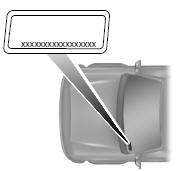
The vehicle identification number is located on the driver’s side instrument panel.
Please note that in the graphic, XXXX is representative of your vehicle identification number.
The Vehicle Identification Number (VIN) contains the following information:
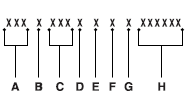
A. World manufacturer identifier
B. Brake system / Gross Vehicle Weight Rating (GVWR) / Restraint Devices and their location
C. Make, vehicle line, series, body type
D. Engine type
E. Check digit
F. Model year
G. Assembly plant
H. Production sequence number.
 Part numbers
1 Refer to scheduled maintenance information for the appropriate
intervals for changing the spark plugs.
Note: Replace the spark plugs with ones that meet Ford material and
design specification ...
 Vehicle certification label
The National Highway Traffic Safety
Administration Regulations require
that a Safety Compliance Certification
Label be affixed to a vehicle and
prescribe where the Safety
Compliance Certificati ...
Other materials:
General Procedures
Camshaft Bearing Journal Diameter
NOTE: Refer to the appropriate Section 303-01 for the specification.
Measure each camshaft journal diameter in 2 directions.
Camshaft Journal to Bearing Clearance - OHC Engines
NOTE: Refer to the appropriate Section 303-01 for the specification.
...
Diagnosis and Testing
Handles, Locks, Latches and Entry Systems
Special Tool(s)
Material
DTC Charts
Diagnostics in this manual assume a certain skill level and knowledge of
Ford-specific diagnostic practices. Refer to Diagnostic Methods in Section
100-00 for information about these practices.
DDM DTC C ...
Fuel Charging and Controls - 3.5L GTDI
SPECIFICATIONS
Material
Torque Specifications
a Refer to the procedure in this section.
DESCRIPTION AND OPERATION
Fuel Charging and Controls
3.5L Gasoline Turbocharged Direct Injection (GTDI)
WARNING: Do
not smoke, carry lighted tobacco or have an open flame of any type when working
on or n ...
