
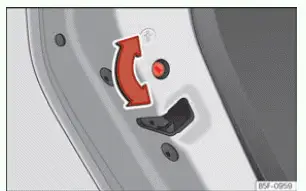
Fig. 55 Left door child lock.
The child safety lock prevents the rear doors of the Seat Ateca from being opened using their interior door handles. Its primary purpose is to reduce the risk of children accidentally opening a rear door while the vehicle is moving. When the child lock is engaged, pulling the interior handle will not release the affected door, helping to protect young passengers who may not fully understand the dangers of opening a door during a journey.
The child lock operates independently of the vehicle's electronic central locking and unlocking systems. It is a separate mechanical safety feature fitted exclusively to the rear doors, so locking or unlocking the vehicle with the remote control does not change its setting. Each rear door must be adjusted manually using the vehicle key, following the activation or deactivation procedure described below.
Activating the child lock
- Unlock the Seat Ateca and open the rear door on which you want to activate the child safety lock. The adjustment mechanism is accessible only when the door is open, so make sure the door is held securely while carrying out the procedure.
- With the rear door open, insert the vehicle key into the child lock adjustment slot. For the left rear door, turn the slot clockwise, as illustrated in Fig. 55. For the right rear door, turn the slot anticlockwise. This engages the mechanical child safety lock on the selected door.
Once the child lock has been activated, the affected rear door can no longer be opened using its interior handle. It can only be opened from outside, provided that the vehicle's normal locking system permits the door to be opened. This prevents a child seated in the rear from releasing the door independently.
Deactivating the child lock
- Unlock the vehicle and open the rear door on which you want to deactivate the child safety lock. Access the adjustment slot on the edge of the open door before changing its position.
- Insert the vehicle key into the adjustment slot and turn it anticlockwise for the left rear door, as shown in Fig. 55, or clockwise for the right rear door. This releases the child safety lock and restores the ability to open the affected door using its interior handle, subject to the normal operation of the vehicle's locking system.
WARNING When a rear door child lock is activated, that door cannot be opened from inside the vehicle. Occupants who are unable to reach or operate another door may therefore become trapped if the vehicle is locked or if nobody outside is available to open the affected door.
In an emergency, passengers may be unable to leave the Seat Ateca independently or reach a place of safety. This is particularly dangerous for children and people who require assistance, as they may not be able to unlock another door or obtain help quickly.
- Never leave children or people who need assistance unattended inside the vehicle when the doors are locked. Before leaving the vehicle, make sure that everyone has exited safely, especially when the rear door child locks are engaged.
WARNING Children, people requiring assistance and animals left unattended inside a closed vehicle may be exposed to dangerously high or low temperatures. The passenger compartment can heat up or cool down significantly depending on the weather, and occupants who cannot leave independently may suffer severe illness, serious injuries or death.
- Never leave children, people who need assistance or animals unattended in the Seat Ateca, even if the vehicle is parked for only a short time. The child safety locks and central locking system must never be treated as a substitute for responsible supervision.
 Emergency unlocking or locking of
the driver's door
Fig. 52 Driver's door handle: hidden lock
cylinder.
Fig. 53 Driver's door handle: pry the cover
open.
If the central locking system stops working, the driver's door of the Seat Ateca ...
 Rear lid
...
Other materials:
General operating tips
Manual Climate Control
• To reduce fog build-up on the windshield during humid weather, select
Defrost. You can also improve clearing by increasing the temperature
and fan speed.
• To reduce humidity build-up inside the vehicle, do not drive with the
system off or with recirculated air en ...
Specifications, Description and Operation
SPECIFICATIONS
Material
Torque Specifications
a Refer
to the procedure for the specification.
General Specifications
Solenoid Operation Chart
a Turns
on above 8 km/h (5 mph).
b Turns
off above 8 km/h (5 mph).
CB = Clutch brake
NC = Normally closed
NH = Normally high
...
Assistance systems and vehicle settings
Fig. 12 Schematic representation: Assistance
systems and vehicle settings
Selecting Driver assistance from the infotainment system's main menu opens the section containing the available driver assistance functions and related vehicle settings. This menu allows the driver to review the conf ...
