
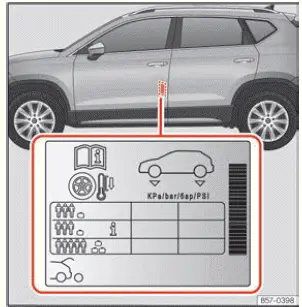
Fig. 217 Location of the tyre pressure sticker.
Maintaining the correct tyre inflation pressure and adopting a smooth, considerate driving style can significantly extend the service life of the tyres fitted to your Seat Ateca. Tyre wear is influenced by several factors, including inflation pressure, vehicle loading, driving habits and wheel alignment. Regular inspections and appropriate maintenance help preserve tyre performance, improve driving comfort and reduce the likelihood of premature replacement.
- Check the inflation pressure of all tyres at least once a month and before setting off on any long journey. Regular pressure checks are particularly important because tyres can gradually lose air without showing obvious signs of under-inflation.
- Always measure tyre pressure when the tyres are cold. Driving causes the tyres to warm up and the internal pressure to rise, so a reading taken immediately after a journey may be higher than the normal cold inflation pressure. Never release air from warm tyres simply to bring the reading down to the specified cold pressure.
- Adjust the inflation pressure according to the load being carried by the vehicle. Use the appropriate values shown on the tyre pressure information sticker ››› Fig. 217, taking into account whether the Seat Ateca is lightly loaded or carrying passengers and luggage.
- If your vehicle is equipped with a tyre pressure monitoring indicator, save or store the updated tyre pressure settings after adjusting the inflation pressures. This allows the system to use the new settings as its reference for subsequent monitoring.
- Avoid taking corners at excessive speed and accelerating aggressively. Smooth steering inputs, progressive acceleration and controlled braking reduce unnecessary stress on the tyres and help limit premature tread wear.
- Inspect the tyres periodically for uneven or unusual wear patterns. Differences in tread wear across a tyre or between individual wheels may indicate incorrect inflation pressure, wheel imbalance or a problem with wheel alignment that requires attention.
Tyre pressure
The recommended tyre inflation pressures are specified on the information sticker attached to the rear section of the front left door frame ››› Fig. 217. This label provides the pressure values applicable to the vehicle's approved tyre equipment and different loading conditions. Refer to it whenever checking or adjusting the tyre pressures rather than relying on a general pressure value that may not be suitable for your particular Seat Ateca.
Both insufficient and excessive tyre pressure can considerably shorten tyre life and adversely affect the vehicle's handling, ride comfort and overall driving behaviour. Under-inflated tyres flex more than intended during operation, while excessive pressure changes the way the tyre contacts the road. Correct inflation is especially important when driving at higher speeds, when the tyres are subjected to greater demands and incorrect pressure can have more serious consequences for their performance and durability.
The tyre pressures must correspond to the vehicle's current load. When carrying additional passengers, luggage or other permitted cargo, check whether the pressures need to be increased. If the Seat Ateca is going to be driven fully loaded, inflate the tyres to the values specified for maximum vehicle loading on the pressure sticker ››› Fig. 217. Using the correct pressure for the load helps the tyres support the vehicle properly and reduces unnecessary wear.
Remember to include the spare wheel whenever checking tyre inflation pressures. Although it may not be used regularly, the spare wheel must be ready for installation if one of the normal road tyres becomes damaged. Keep a standard spare wheel inflated to the highest pressure specified for the vehicle's road wheels, so that it is adequately prepared for use when required.
If the vehicle is equipped with a compact temporary spare wheel in size 125/70 R16 or 125/70 R18, its specified inflation pressure is 4.2 bar. This value is also indicated on the tyre pressure label ››› Fig. 217. The compact spare wheel has different inflation requirements from the normal road wheels, so its pressure must be checked against the value prescribed for that particular spare wheel.
Depending on the vehicle's equipment and approved tyre configuration, the inflation pressure may be adjusted to the value specified for a medium vehicle load to improve ride comfort. This setting is identified by the comfort tyre pressure symbol  on the tyre pressure sticker ››› Fig. 217. The comfort setting should only be used when the vehicle's loading conditions permit it and the corresponding pressure is shown on the label.
Driving with the comfort tyre pressure setting may result in a slight increase in fuel consumption compared with the alternative recommended pressure setting. The choice of inflation pressure should therefore take account of both the vehicle's load and the values approved by the manufacturer, rather than being based on ride comfort alone.
Driving style
The way the Seat Ateca is driven has a direct influence on tyre wear. Cornering at high speeds, accelerating sharply and braking heavily place increased forces on the tyre tread, causing the rubber to wear more quickly. Driving manoeuvres that make the tyres squeal are particularly demanding because they involve substantial friction between the tread and the road surface. A smoother driving style, with measured acceleration, controlled braking and appropriate cornering speeds, helps preserve the tyres and promotes more even wear over their service life.
Wheel balance
The wheels fitted to new vehicles are balanced during preparation to ensure that they rotate smoothly and without excessive vibration. Correct wheel balance is important for driving comfort and helps prevent unnecessary stress on the tyres, steering components and suspension system.
Over time, however, certain operating conditions can cause a wheel to become unbalanced. Changes in the distribution of weight around the wheel assembly may produce irregular rotation, sometimes referred to as run-out or imbalance. One of the most noticeable symptoms is vibration transmitted through the steering wheel, particularly while the vehicle is moving.
If a wheel becomes unbalanced, it should be checked and rebalanced by a qualified specialist workshop. Continuing to drive with unbalanced wheels can accelerate tyre wear and place additional strain on the steering and suspension components. Wheel balancing is also necessary whenever a new tyre is fitted or an existing tyre has been repaired, as these procedures can alter the balance of the wheel and tyre assembly.
Incorrect wheel alignment
Incorrect wheel alignment can cause the tyres to wear excessively or unevenly, reducing their useful life and potentially affecting the safety and handling of the vehicle. When the wheels are not aligned as intended, the tyre tread may be subjected to unnecessary friction during normal driving. If you notice unusually rapid wear or a marked difference in tread wear across a tyre, have the wheel alignment checked at an authorised SEAT Official Service. Correcting an alignment problem can help prevent further damage to the tyres and restore the vehicle's intended driving characteristics.
WARNING Incorrect handling, inadequate maintenance or unsuitable inflation pressures can seriously compromise tyre safety. A damaged or improperly inflated tyre may lose pressure suddenly, suffer tread separation or burst while the vehicle is moving. Such failures can result in loss of vehicle control and a serious accident. Always observe the manufacturer's tyre specifications and inspect the tyres regularly.
- The driver is responsible for ensuring that every tyre on the vehicle is inflated to the correct pressure for the current operating and loading conditions. The recommended inflation pressures are shown on the tyre pressure sticker ››› Fig. 217. These values must be observed for all tyres fitted to the Seat Ateca.
- Check the tyre pressures regularly and maintain them at the specified values. Tyres that are operated with insufficient pressure can become excessively hot because of increased flexing during rotation. This can seriously weaken the tyre structure and may lead to dangerous failure.
Severe under-inflation can cause the tyre to overheat, potentially resulting in separation of the tread from the tyre body or a sudden tyre burst. These failures are especially dangerous while driving at higher speeds. Never continue driving with a tyre that is known or suspected to be significantly under-inflated.
- The inflation pressures specified on the vehicle's tyre pressure label apply to cold tyres and must be used as the reference values ››› Fig. 217. Do not attempt to correct the naturally increased pressure of warm tyres by releasing air, as this may leave them under-inflated once they have cooled.
- Measure the cold inflation pressure of the tyres at regular intervals, even when no visible loss of air is apparent. If an adjustment is necessary, increase or reduce the pressure while the tyres are cold until the appropriate value for the vehicle's load is reached. Check all wheels rather than assuming that their pressures remain identical.
- Inspect the tyres frequently for damage, deterioration and signs of excessive or irregular wear. Look for cuts, cracks, bulges, punctures and unusual tread patterns. If damage is discovered or the condition of a tyre is uncertain, have it examined by a qualified specialist before continuing normal use.
- Never exceed the maximum speed rating or load capacity specified for the tyres fitted to the vehicle. These limits are part of the tyre's approved operating characteristics and must be respected even when road conditions appear favourable. Excessive speed or loading can place dangerous stresses on the tyre structure and increase the risk of failure.
For the sake of the environment
Driving with under-inflated tyres increases rolling resistance, which can cause the engine to consume more fuel than necessary. Maintaining the recommended inflation pressures helps reduce unnecessary fuel consumption and the associated environmental impact, while also contributing to longer tyre life and reducing the need for premature tyre replacement.
 New wheels and tyres
All work involving the wheels and tyres of the Seat Ateca should preferably be carried out by a qualified specialist workshop. Professional technicians have the necessary expertise, dedicated tools an ...
 Tread wear indicators
Fig. 218 Tyre profile: tread wear indicators.
Fig. 219 Swapping tyres.
The original tyres fitted to the Seat Ateca have built-in tread wear indicators that provide a visual referen ...
Other materials:
Floor mats
WARNING: Always use floor mats that are designed to fit the
foot well of your vehicle, leaving the pedal area unobstructed,
and which can be firmly secured to retention posts so that they cannot
slip out of position and interfere with the pedals or impair safe
operation of your vehicle in othe ...
Switching the auxiliary heater and
ventilation on and off
The auxiliary heating system in the Seat Ateca can operate with the ignition either switched on or switched off. This allows the passenger compartment to be heated before the engine is started, as well as during suitable vehicle operating conditions. The system can be controlled through the climate ...
Center console
Stow items in the cupholder carefully as items may become loose during
hard braking, acceleration or collisions, including hot drinks which may
spill.
Note: The appearance and features of the center console may be
different than shown based on your vehicle’s option level.
Available consol ...
