
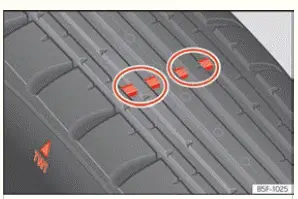
Fig. 218 Tyre profile: tread wear indicators.
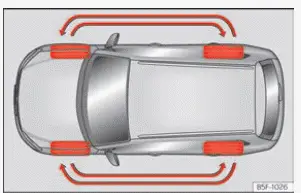
Fig. 219 Swapping tyres.
The original tyres fitted to the Seat Ateca have built-in tread wear indicators that provide a visual reference for assessing tyre wear. These indicators are small, raised sections of rubber approximately 1.6 mm high, positioned at regular intervals along the base of the main tread grooves. They extend across the grooves and become increasingly noticeable as the surrounding tread wears down ››› Fig. 218. Their locations can be identified by the letters "TWI" (Tread Wear Indicator) or small triangular markings moulded into the tyre sidewall. These markings help you locate the indicators when inspecting the tyre's remaining tread depth.
When the tread surface has worn down until it is level with the wear indicators, the tyre has reached a tread depth of approximately 1.6 mm. This represents the minimum permitted tread depth specified here, and the tyre must be replaced with a new one. Do not wait until the tread has worn below the indicators before arranging replacement. Tyres approaching this limit may already provide noticeably less grip on wet roads, even if they have not yet reached the minimum depth.
If the Seat Ateca is frequently driven in a sporty or particularly demanding manner, inspect the tread depth at intervals of approximately 5,000 to 10,000 km (3,000 to 6,000 miles). More frequent checks help identify accelerated or uneven wear caused by intensive acceleration, braking and cornering. When measuring the tread depth, examine the wear indicators in all the main tread grooves rather than checking only one position. The tread may not wear uniformly across its width or around the entire circumference, so inspecting several locations provides a more reliable assessment of the tyre's condition.
Changing wheels around
To encourage more even tyre wear, it is advisable to change the positions of the wheels periodically, following the rotation arrangement illustrated in Fig. 219. The tyres on the front and rear axles may wear at different rates because they are subjected to different steering, braking and driving forces. Moving the wheels between the recommended positions helps distribute this wear more evenly, provided that the tyre type and wheel configuration permit the indicated rotation pattern. As a result, the tyres are more likely to reach the end of their useful service lives at approximately the same time, making replacement and maintenance easier to manage.
WARNING Tyres must be replaced no later than the point at which the tread has worn down to the tread wear indicators. Continuing to drive on tyres that have reached this limit can significantly reduce road grip and compromise the vehicle's handling and braking performance. Failure to replace excessively worn tyres increases the risk of losing control of the Seat Ateca and may result in a serious accident.
- Adequate tread depth is particularly important in difficult driving conditions, including wet, snowy or icy roads. The tread must be deep enough to perform its intended function, and the tyres fitted to the front and rear axles should have approximately comparable tread depths. Significant differences in tyre wear can affect the balance of grip between the axles and may make the vehicle's behaviour less predictable on slippery surfaces.
- Insufficient tread depth has a particularly noticeable effect on driving safety when the road is wet. Worn tyres are less effective at dispersing water from the contact area, increasing the likelihood of aquaplaning when driving through deep puddles or standing water. Reduced tread depth can also adversely affect steering response and cornering grip, while braking performance may deteriorate because the tyres cannot maintain adequate contact with the road surface. These effects become especially dangerous when the vehicle is travelling at higher speeds.
- Always adjust your driving speed to the condition of the tyres and the prevailing road conditions. Reduce speed when grip is limited by rain, standing water, snow or ice, and avoid sudden steering or braking manoeuvres. Driving too quickly on worn tyres can cause the vehicle to lose traction unexpectedly, increasing the risk of skidding or losing control.
Wheel nuts
The wheel nuts and wheel rims are designed to work together as a matched assembly, ensuring that each wheel is securely attached to the vehicle. When fitting a different type of wheel, such as an alloy rim or a wheel equipped with a winter tyre, it is essential to use the correct fastening components. The wheel nuts must have the appropriate length and the correct shape at the seating surface so that they fit the wheel properly. Using suitable fasteners helps maintain secure wheel attachment and ensures that the wheel installation does not interfere with the correct operation of the braking system. Wheel nuts intended for one rim design must not automatically be assumed suitable for another.
The wheel nuts must be clean and their threads must allow them to turn smoothly during installation. Dirt, corrosion or damaged threads can interfere with correct fastening and make it difficult to achieve the required tightening torque. If a wheel nut does not turn freely, its condition and compatibility should be checked before the wheel is secured.
Wheels equipped with anti-theft wheel nuts require a special adapter for removal and installation. The adapter is designed to engage with the unique fastening profile of the locking nut, allowing it to be turned using the appropriate wheel-changing tool. Keep the adapter available so that the wheel can be removed when necessary, including during tyre repairs or emergency wheel replacement.
WARNING Never apply grease, oil or other lubricants to the wheel nuts or their threads. Lubrication changes the friction conditions during tightening and can affect the relationship between the applied tightening torque and the clamping force holding the wheel in place. This may compromise the security of the wheel attachment and create a serious safety hazard.
- Only use wheel nuts specifically intended for the wheels fitted to the Seat Ateca. Their dimensions, thread specifications and seating surfaces must match the wheel design. Incorrect wheel nuts may fail to secure the wheel properly, even if they appear to fit during installation.
- Wheel nuts must be tightened to the prescribed torque. If the tightening torque is insufficient, the nuts may gradually loosen while the vehicle is moving, potentially allowing the wheel to become insecure and causing a serious accident. Excessive tightening is also dangerous because it can damage the wheel nuts, their threads or the corresponding fastening components. Always use the correct tightening procedure and specified torque rather than tightening the nuts by feel alone.
Winter tyres
- Winter tyres must be fitted to all four wheels of the Seat Ateca. Installing them on only one axle can create a substantial difference in grip between the front and rear wheels, particularly on snow-covered or icy roads. Using a complete set helps maintain more consistent steering, braking and handling characteristics in winter conditions.
- Use only winter tyres that are approved for your vehicle. The tyres must meet the relevant size, load and other technical requirements specified for the Seat Ateca. Before purchasing or fitting winter tyres, confirm that the selected specification is suitable for the vehicle and its wheel configuration.
- Remember that the maximum permitted speed of winter tyres may be lower than that of the summer tyres normally fitted to the vehicle. Always observe the speed rating marked on the winter tyres and do not exceed their approved maximum speed, even if the vehicle itself is capable of travelling faster. The tyre's speed limitation must be taken into account when driving.
- Winter tyres gradually lose their effectiveness as the tread wears down. Although a tyre may still have some remaining tread, reduced tread depth can impair its ability to provide traction on snow and other winter road surfaces. Check the tread condition regularly and replace winter tyres when their wear makes them unsuitable for the conditions in which they are used.
- After fitting winter wheels, always check and, if necessary, adjust the inflation pressure of every tyre. Use the recommended cold inflation pressures shown on the tyre pressure information sticker located on the rear section of the front left door frame. Select the values appropriate for the tyre equipment and the vehicle's current load, and do not assume that the pressures used with the previous set of wheels are automatically correct for the newly installed tyres.
Winter tyres can considerably improve the handling and traction of the Seat Ateca when driving on snow-covered, icy or otherwise wintry roads. Their rubber compound and tread design are intended to provide better grip in cold conditions than conventional summer tyres. Summer tyres are designed with different priorities in mind, including their tread width, rubber composition and tread pattern. As a result, they generally offer significantly less traction on snow and ice, making acceleration, steering and braking more difficult under winter driving conditions.
This difference is particularly noticeable on vehicles fitted with wide-section tyres or high-speed tyres identified by the speed rating letters H, V or Y on the sidewall. Such tyres may provide suitable handling characteristics under normal road conditions but can offer considerably less grip when temperatures fall and the road surface becomes covered with snow or ice. For this reason, selecting tyres appropriate to the season is especially important for maintaining predictable handling and effective braking.
Only fit winter tyres of a type and size approved for your Seat Ateca. The permitted tyre dimensions are listed in the vehicle's official documentation, such as the EC Certificate of Conformity (COC) or the corresponding national vehicle documents. These specifications should be checked before purchasing winter tyres to ensure that the chosen equipment is suitable for the vehicle. The form and content of the documentation may differ depending on the country in which the vehicle is registered.
Winter tyres lose a substantial proportion of their intended winter performance once the tread depth has worn down to approximately 4 mm. Although the tyres may still have tread remaining, their ability to provide effective traction on snow and other slippery winter surfaces becomes noticeably reduced. Regularly check the tread depth and take this reduction in performance into account when deciding whether the tyres remain suitable for winter use.
Age also has a significant effect on winter tyre performance. Over time, the rubber compound can change its characteristics, reducing the tyre's ability to provide the grip expected in cold weather. Consequently, an older winter tyre may perform poorly even when its tread depth remains considerably greater than 4 mm. When assessing winter tyres, consider both their age and the condition of the tread rather than relying on tread depth alone.
Every winter tyre carries a speed rating marked by a letter on its sidewall. This designation identifies the maximum speed permitted for that tyre under the applicable operating conditions. The rating must be observed even if the Seat Ateca is capable of reaching a higher speed. Before fitting winter tyres, check their speed classification and ensure that it is appropriate for the vehicle and its intended use.
A speed warning can be configured through the infotainment system to help the driver observe the speed limit applicable to the fitted tyres. Open the Vehicle settings menu and select the Tyres section to set the relevant speed warning. This function is particularly useful when winter tyres have a lower permitted maximum speed than the summer tyres normally installed on the vehicle.
If the vehicle is capable of exceeding the maximum speed permitted for its winter tyres, an appropriate speed limitation sticker must be displayed where it is clearly visible to the driver, where required by applicable regulations. These stickers can be obtained from an authorised SEAT Official Service or a qualified specialist workshop. The sticker serves as a reminder of the tyre's speed restriction, but it does not replace the driver's responsibility to remain within that limit. Always observe the legal requirements governing winter tyre speed ratings and warning labels in the country concerned.
Approved all-weather tyres may also be used as an alternative to dedicated winter tyres. When choosing all-weather tyres for the Seat Ateca, ensure that their dimensions and technical specifications are suitable for the vehicle and consider the winter road conditions in which they will be used. Their suitability should be assessed in relation to the expected driving conditions rather than assuming that all all-weather tyres provide identical winter performance.
Using winter tyres with a V-rating
Winter tyres marked with the speed rating letter V are generally associated with a maximum speed of 240 km/h (149 mph). However, this nominal rating does not automatically mean that the tyres may be used at that speed on every vehicle. Technical restrictions may apply, and the actual maximum permissible speed for the winter tyres fitted to your Seat Ateca can be considerably lower. The permitted speed depends directly on the vehicle's maximum axle loads and the load rating specified for the particular tyres. These factors must be considered together when determining the safe operating limit of V-rated winter tyres.
To establish the maximum permissible speed for the V-rated winter tyres fitted to your vehicle, consult an authorised SEAT Official Service. The workshop can assess the relevant axle weight specifications and the load index of the selected tyres to determine the applicable speed restriction. This is particularly important when the tyre's nominal speed rating alone does not provide enough information to establish the correct limit for the vehicle.
WARNING Never exceed the maximum speed permitted for the winter tyres installed on your vehicle. Driving faster than the tyres are approved to withstand can place excessive stress on their structure and may cause sudden tyre failure. A damaged or failed tyre can lead to an immediate loss of traction or vehicle control, creating a serious risk of an accident. Always observe the applicable tyre speed limit, even when road and weather conditions appear favourable.
For the sake of the environment
Once winter conditions have ended, replace the winter tyres with suitable summer tyres at the appropriate time. When temperatures rise above approximately +7°C (+45°F), summer tyres generally provide better performance under the corresponding road conditions. Using summer tyres during warmer weather can also reduce rolling noise, limit unnecessary tyre wear and lower energy consumption. Changing tyres according to the season therefore helps maintain suitable driving characteristics while reducing avoidable fuel consumption and premature tyre deterioration.
 Tyre life
Fig. 217 Location of the tyre pressure sticker.
Maintaining the correct tyre inflation pressure and adopting a smooth, considerate driving style can significantly extend the service life of ...
 Snow chains
 may only be fitted to the front wheels of the Seat Ateca. This restriction also applies to models equipped with four-wheel drive. Do not install snow chains on the rear wheels, as the vehi ...
Other materials:
Objects that are not detected
Fig. 120 A vehicle turning and another
stationary.
Adaptive Cruise Control is designed to detect and respond to vehicles travelling in the same direction within the radar sensor's operating range. It is not a general obstacle detection system and cannot be relied upon to identify every ...
Using cruise control
WARNING: Do not use cruise control in heavy traffic, on
winding roads or when the road surface is slippery. This could
result in loss of vehicle control, serious injury or death.
WARNING: When you are going downhill, your vehicle speed
may increase above the set speed. The system will not apply ...
Instructions for tow-starting and
towing
When the Seat Ateca is being towed with its hazard warning lights activated, the driver can still indicate an intended change of direction using the turn signals. With the ignition switched on, operate the turn signal lever in the required direction. While the selected turn signal is operating, the ...
