
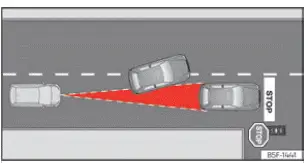
Fig. 120 A vehicle turning and another
stationary.
Adaptive Cruise Control is designed to detect and respond to vehicles travelling in the same direction within the radar sensor's operating range. It is not a general obstacle detection system and cannot be relied upon to identify every road user or object ahead of the Seat Ateca. In particular, ACC does not detect or respond appropriately to the following categories of road users and obstacles:
- People, including pedestrians who are standing, walking or moving across the vehicle's intended path. The driver must recognise pedestrians independently and brake whenever necessary.
- Animals on or near the road. ACC is not designed to identify animals as relevant vehicles for speed and distance regulation, regardless of whether they are stationary or moving.
- Vehicles approaching from the opposite direction or crossing the road. ACC is intended to regulate distance from vehicles travelling in the same direction and must not be relied upon to prevent collisions with crossing or oncoming traffic.
- Other stationary obstacles, including objects or obstructions that are not moving with the surrounding traffic. The driver must remain attentive to the road ahead and take appropriate action when approaching such hazards.
ACC does not react to stationary vehicles. This limitation is particularly important when approaching stopped traffic, a stationary vehicle in the driving lane or an obstruction that becomes visible only after another vehicle changes position. The driver must not assume that ACC will automatically slow the Seat Ateca or bring it to a stop in response to a stationary vehicle.
For example, ACC may initially detect and follow a moving vehicle ahead. If that vehicle then turns off the road or changes lanes, a stationary vehicle may suddenly become visible directly in front of the Seat Ateca. As shown in Fig. 120, ACC will not react to the newly exposed stationary vehicle. The driver must recognise the hazard and apply the brakes in sufficient time to avoid a collision. This situation demonstrates why continuous observation of the road is essential even when Adaptive Cruise Control is actively regulating speed.
WARNING Using Adaptive Cruise Control in the situations described above can result in serious accidents and injuries. The system may fail to detect relevant hazards, respond too slowly or regulate speed in a way that is unsuitable for the road and traffic conditions. Inappropriate use may also lead to violations of traffic regulations. The driver must always remain responsible for controlling the vehicle, observing the surrounding traffic and intervening whenever necessary. Do not use ACC when its limitations could prevent safe operation.
Troubleshooting
 ACC not available
If Adaptive Cruise Control becomes unavailable, the corresponding indicator lamp illuminates yellow in the instrument cluster. This warning indicates that the system cannot currently provide its normal speed and distance regulation functions. The cause may be related to the radar sensor, the vehicle's operating conditions or a malfunction requiring inspection.
- The front radar sensor may be dirty, obstructed or incorrectly aligned. Contamination, snow, ice or damage affecting the sensor area can prevent reliable detection of vehicles ahead. Inspect the sensor area and follow the relevant cleaning and maintenance instructions.
Observe the warnings and operating limitations explained at the beginning of this chapter, particularly those concerning radar visibility, environmental interference and sensor alignment. If the sensor has been damaged or its position may have changed, have it checked by a qualified specialist rather than attempting to adjust it yourself.
- A fault or temporary malfunction may have occurred in the ACC system. Switch off the vehicle's ignition, wait a few minutes and then switch the ignition on again. Check whether the warning has disappeared and whether the system is available. Do not attempt to use ACC while the malfunction indication remains active.
- If the warning persists or ACC remains unavailable after the suggested checks, contact a qualified specialist workshop. The system should be inspected to identify the cause of the malfunction and restore correct operation before Adaptive Cruise Control is used again.
The ACC does not work as expected
- Check that the conditions required for correct operation of the front radar sensor are satisfied. The sensor must be unobstructed, correctly aligned and capable of monitoring the road ahead. Dirt, adverse weather, damage or interference from the surrounding environment may affect detection and cause ACC to behave unexpectedly.
- If the vehicle's brakes overheat, ACC regulation is interrupted automatically. This prevents the system from continuing normal regulation while the braking system is affected by excessive temperature. Allow the brakes to cool before attempting to use ACC again.
Once the brakes have cooled sufficiently, check whether Adaptive Cruise Control operates normally. If the function remains unavailable or regulation is interrupted again, have the vehicle inspected by a qualified specialist workshop.
- Unusual noises may be heard when ACC applies the brakes automatically. Such sounds can occur during normal operation of the braking system and do not necessarily indicate a malfunction. However, if the braking response itself is abnormal or the system does not operate as described, stop using ACC and arrange for an inspection.
The following conditions may lead the ACC not to react:
- The accelerator or brake pedal is being pressed. Driver input can interrupt or override ACC regulation, so the system may not provide its normal automatic response while either pedal is operated.
- No gear is engaged, or the transmission selector is in reverse position R. ACC requires an appropriate forward driving gear and cannot regulate normally when the transmission is not in a suitable position.
- The vehicle is reversing. Adaptive Cruise Control is intended for forward driving and does not provide its normal speed and distance regulation while the Seat Ateca is moving backwards.
- Electronic Stability Control (ESC) is actively intervening. When ESC is regulating vehicle stability, ACC operation may be interrupted because the stability intervention takes priority over automatic speed regulation.
- The driver is not wearing the seat belt. ACC may be unavailable when the driver's seat belt is not fastened, as the required operating conditions are not satisfied.
- The engine speed is excessively high or low. On vehicles where engine speed and gear selection affect ACC operation, regulation may be interrupted when the engine is operating outside the permitted range.
- One of the vehicle's brake lights is faulty. A malfunction affecting the brake lighting system can prevent ACC from operating normally because the required vehicle conditions are not met.
- A brake light on a connected trailer is defective. Faults affecting the trailer's brake lighting may also restrict ACC operation when the vehicle is towing.
- The parking brake is applied. ACC cannot provide its normal driving regulation while the parking brake is engaged.
- The vehicle is travelling on an excessively steep gradient. Severe uphill or downhill slopes may exceed the conditions under which ACC can regulate speed and distance appropriately.
 ACC system limitations
Adaptive Cruise Control (ACC) has technical and operational limitations that must be considered whenever the system is used. Although ACC can assist the driver by regulating speed and maintaining a se ...

Other materials:
Personal Safety System
The Personal Safety System provides an improved overall level of frontal
crash protection to front seat occupants and is designed to help further
reduce the risk of airbag-related injuries. The system is able to analyze
different occupant conditions and crash severity before activating the
appro ...
Child seat positioning
WARNING: Airbags can kill or injure a child in a child seat.
Never place a rear-facing child seat in front of an active airbag.
If you must use a forward-facing child seat in the front seat, move the
vehicle seat upon which the child seat is installed all the way back.
When possible, all c ...
Removal and Installation
Generator - 2.0L GTDI
Removal
Disconnect the battery. For additional information, refer to Section
414-01.
Remove the upper Charge Air Cooler (CAC) pipe. For additional
information, refer to Intake Air System Components - Exploded View
in Section 303-12.
...
