
Adaptive Cruise Control (ACC) has technical and operational limitations that must be considered whenever the system is used. Although ACC can assist the driver by regulating speed and maintaining a selected distance from vehicles ahead, it cannot reliably identify every traffic situation or respond appropriately under all road and weather conditions. Certain environments can restrict the front radar sensor's ability to detect vehicles, while others require more direct control of acceleration and braking than the system can provide.
For these reasons, SEAT advises against using Adaptive Cruise Control in the following circumstances. In such situations, the driver should control the Seat Ateca's speed and following distance manually rather than relying on automatic regulation:
- During heavy rain, snowfall or dense fog, when adverse weather can impair radar detection and reduce the driver's ability to observe traffic ahead. These conditions can also increase braking distances and make automatic speed regulation unsuitable.
- When travelling through tunnels, where the enclosed surroundings and changes in the driving environment may interfere with reliable radar operation. The driver should remain in direct control of the vehicle's speed.
- On sections of road affected by construction or roadworks. Temporary lane arrangements, barriers, construction equipment and unexpected changes in traffic flow can create situations that ACC may not interpret correctly.
- On winding roads or routes with frequent bends, including mountain roads. The radar sensor may have difficulty maintaining consistent detection of the vehicle ahead when the road changes direction sharply.
- When driving off-road, where uneven terrain, unpredictable obstacles and changing surface conditions require direct driver control. ACC is not intended for use on routes without a suitable road surface.
- Inside covered or enclosed car parks, where nearby walls, structural elements and other vehicles can affect radar detection. The confined space also requires careful manual control at low speeds.
- On roads containing embedded metal objects, such as railway or tram tracks. Metallic structures can affect radar signals and interfere with the sensor's ability to assess the surrounding traffic accurately.
- On roads covered with loose gravel, where reduced tyre grip and changing surface conditions can make automatic speed regulation inappropriate. The driver must adapt acceleration and braking to the available traction.
Even when ACC is being used under generally suitable conditions, certain traffic situations require particular attention. The driver must understand that the system's ability to recognise vehicles depends on their position, movement and visibility within the radar sensor's detection area. The following examples illustrate circumstances in which ACC may respond differently from what the driver expects.
On curves
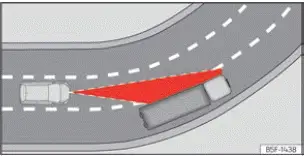
Fig. 117 Vehicle on a bend.
When the Seat Ateca enters or travels through a bend, the front radar sensor may temporarily lose sight of the vehicle travelling ahead. Depending on the shape of the road and the relative positions of surrounding vehicles, ACC may also detect a vehicle in an adjacent lane and use that information when regulating speed or following distance, as illustrated in Fig. 117. This can result in unexpected acceleration or deceleration. The driver must therefore monitor traffic carefully on curved roads and be ready to brake or adjust speed manually if the system does not respond appropriately.
Vehicles outside the sensor zone
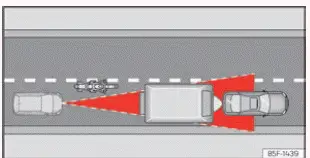
Fig. 118 Motorcyclist ahead out of range of the
radar sensor.
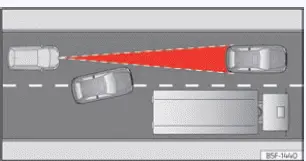
Fig. 119 Vehicle changing lanes.
ACC relies on the front radar sensor to identify relevant vehicles within its detection area. If another vehicle is positioned outside that area, moves into it unexpectedly or has an unusual shape or load, the system may fail to respond, react too late or regulate speed and distance in a manner that does not match the actual traffic situation. Particular care is required in the following circumstances:
- Vehicles travelling outside the normal alignment of the traffic lane or positioned near the edge of the radar sensor's detection area may not be recognised reliably. This can occur with motorcycles, which may travel towards one side of a lane and present a relatively narrow detection target, as shown in Fig. 118. The driver must not assume that ACC will always detect a motorcycle or maintain an appropriate distance from it.
- Vehicles that change lanes directly in front of the Seat Ateca may enter the radar detection area at a very short distance, as illustrated in Fig. 119. ACC may not have sufficient time to recognise the vehicle and reduce speed appropriately. If another vehicle moves into your lane unexpectedly, brake immediately whenever necessary to restore a safe following distance.
- Vehicles carrying loads or accessories that extend beyond their normal body dimensions may be detected differently from ordinary vehicles. Protruding objects at the sides, rear or roof can affect how the radar interprets the vehicle's position and dimensions. Maintain sufficient clearance and do not rely on ACC to assess the space required around such loads.
 Special driving situations
Fig. 116 On the instrument cluster display:
ACC active, vehicle detected on the left.
Adaptive Cruise Control includes functions intended to assist in certain traffic situations, but its ...
 Objects that are not detected
Fig. 120 A vehicle turning and another
stationary.
Adaptive Cruise Control is designed to detect and respond to vehicles travelling in the same direction within the radar sensor's operat ...
Other materials:
Programming the auxiliary heater
Before programming the auxiliary heating system, make sure that the date and time displayed by the Seat Ateca are correct. The scheduled heating and ventilation functions rely on the vehicle's clock to determine when they should operate. An incorrect time setting may cause the system to start or fin ...
Transporting the vehicle
If you need to have your vehicle towed, contact a professional towing
service or, if you are a member of a roadside assistance program, your
roadside assistance service provider.
We recommend the use of a wheel lift and dollies or flatbed equipment
to tow your vehicle. Do not tow with a slin ...
In-Vehicle Repair
Intake Manifold
Removal
With vehicle in NEUTRAL, position it on a hoist. For additional
information, refer to Section 100-02.
Loosen the 4 retainers and remove the underbody shield.
Disconnect the battery ground cable. For additional information, refer
to Section 414-01.
...
