
Avoid running out of fuel because this situation may have an adverse effect on powertrain components.
If you have run out of fuel: • You may need to cycle the ignition from off to on several times after refueling to allow the fuel system to pump the fuel from the tank to the engine. On restarting, crank time will be a few seconds longer than normal. With keyless ignition, just start the engine. Crank time will be longer than usual.
• Normally, adding 1 gallon (3.8 liters) of fuel is enough to restart the engine. If the vehicle is out of fuel and on a steep grade, more than 1 gallon (3.8 liters) may be required.
• The service engine soon indicator may come on. For more information on the service engine soon indicator, see Warning Lamps and Indicators in the Instrument Cluster chapter.
Refilling with a Portable Fuel Container
WARNING:
Do not insert the nozzle of a portable fuel container or aftermarket funnel into the capless fuel system. This could damage the fuel system and its seal, and may cause fuel to run onto the ground instead of filling the tank, which could result in serious personal injury.
WARNING:
Do not try to pry open or push open the capless fuel system with foreign objects. This could damage the fuel system and its seal and cause injury to you or others.
Note:
Do not use aftermarket funnels; they will not work with the capless fuel system and can damage it. The included funnel has been specially designed to work safely with your vehicle.
When filling the vehicle’s fuel tank from a portable fuel container, use the funnel included with the vehicle.
1. Locate the white plastic funnel in the spare tire compartment.
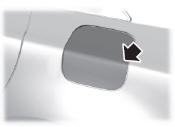
2. To open the fuel filler door, press the center of the rear edge and then release.
3. Slowly insert the funnel into the capless fuel system.

4. Fill the vehicle with fuel from the portable fuel container.
5. When done, clean the funnel or properly dispose of it. Extra funnels can be purchased from your authorized dealer if you choose to dispose of the funnel.
 Fuel quality
Note: Use of any fuel other than those recommended may cause
powertrain damage and a loss of vehicle performance; repairs may not be
covered under warranty.
Choosing the Right Fuel (Gasoline Engine ...
 Refueling
WARNING: Fuel vapor burns violently and a fuel fire can cause
severe injuries. To help avoid injuries to you and others:
• Read and follow all the instructions on the pump island.
• Turn off ...
Other materials:
Diagnostic Methods
Effective Diagnostic Techniques
NOTE: Do not use this document in place of Ford-prescribed Symptom
Based Diagnostics or Workshop Manual diagnostics. Diagnostic Methods is intended
to provide Ford vehicle diagnostic information only for support of
Ford-prescribed diagnostics.
The following di ...
Economical driving
Fuel economy is affected by several things, such as how you drive, the
conditions you drive under and how you maintain your vehicle.
There are some things to keep in mind that may improve your fuel
economy:
• Accelerate and slow down in a smooth, moderate fashion.
• Drive at steady spee ...
Climate features
Press the lower right corner on the touchscreen to access your climate
control features. Depending on your vehicle line and option package,
your climate screen may look different from the screen shown here.
A. Power: Touch to switch the system off and on. Outside air cannot
enter your vehicle ...
