
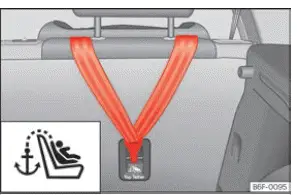
Fig. 38 Rear part of the rear seats: securing
rings for the Top Tether belt.
Child restraint systems equipped with a Top Tether attachment have an additional securing strap that connects the upper part of the child seat to a designated anchorage point in the vehicle. In the Seat Ateca, this anchorage is located on the rear surface of the rear seat backrest, facing the luggage compartment. The attachment point is identified by the symbol  and is illustrated in Fig. 38. When correctly connected and tightened, the Top Tether strap provides additional restraint and helps keep the child seat securely positioned during a collision.
The main purpose of the Top Tether system is to limit the forward movement and rotation of the child restraint during a frontal impact. By restricting this movement, the securing strap helps reduce the possibility of the child's head striking the seat in front or another part of the vehicle interior. The Top Tether is intended to work together with the child seat's primary attachment system and must be used whenever required by the restraint manufacturer's approved installation procedure.
Use of Top Tether on rear-facing child restraints
Relatively few rear-facing child restraint systems are designed to use a Top Tether strap. Their attachment arrangements may differ from those used for forward-facing child seats, so the installation procedure must never be assumed to be identical. If a rear-facing child restraint is equipped with a Top Tether system, carefully read the manufacturer's instructions before installation and follow the specified routing, anchorage and adjustment procedures. Only use the Top Tether arrangement approved for that particular child seat.
Locking the tether belt
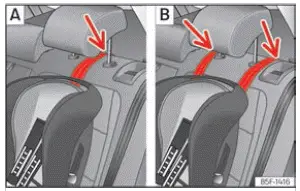
Fig. 39 Rear seats: adjustment and assembly
according to the Top Tether belt.
- Extend and position the Top Tether strap in accordance with the child seat manufacturer's installation instructions. Make sure the strap is correctly arranged before attaching it to the vehicle anchorage point, and check that it is not twisted or caught between parts of the child restraint.
- Guide the Top Tether strap beneath the rear head restraint, following the routing specified for the particular child seat. If necessary, raise or remove the head restraint as permitted by the manufacturer's instructions to obtain the correct strap position, as illustrated in Fig. 39. The strap must follow its designated path without being obstructed by the head restraint.
- Route the strap towards the rear of the seat backrest and attach its hook securely to the designated Top Tether anchorage point shown in Fig. 38. Check that the hook is correctly engaged with the anchorage and that the strap has not been connected to an unrelated luggage compartment fitting.
- Tighten the Top Tether strap firmly according to the child restraint manufacturer's instructions. Remove the specified amount of slack and check that the child seat remains correctly positioned. The strap must be sufficiently secure to perform its restraining function without altering the approved installation of the child seat.
Release the tether belt
- Before removing the child restraint, loosen the Top Tether strap using the adjustment mechanism and procedure specified by its manufacturer. Release the tension in a controlled manner so that the attachment hook can be disconnected without forcing the anchorage or damaging the strap.
- Press the locking mechanism on the Top Tether attachment hook and disengage it from the designated anchorage bracket. Once the hook has been released, the remaining child seat attachments can be disconnected according to the manufacturer's removal instructions.
WARNING Incorrect installation of a child restraint system increases the risk of serious injury during a collision. A Top Tether strap that is attached to the wrong point, routed incorrectly or left insufficiently secured may not provide the restraint required to limit the movement of the child seat. Always use the designated anchorage points and follow the child seat manufacturer's instructions.
- Never attach the Top Tether strap to a luggage fastening hook in the luggage compartment. These hooks are not intended to serve as child restraint anchorages and must not be substituted for the designated Top Tether securing points. Use only the anchorage identified for the child restraint system.
- Never attach luggage, cargo straps or other objects to the lower ISOFIX anchorages or the Top Tether anchorage points. These fittings are specifically designed for securing approved child restraint systems. Using them for other purposes may interfere with the correct installation of a child seat or subject the anchorage points to loads for which they are not intended.
WARNING Child restraint anchorage points are designed to withstand the forces generated by correctly installed and adjusted child restraint systems. They must never be used to secure adult seat belts, additional harnesses, luggage or any other equipment to the vehicle. Using these anchorages for purposes other than those specified can compromise their intended function and create a serious safety risk during an accident.
Fitting a child seat using the seat belt
If you intend to install a child restraint with universal approval category (U) using the vehicle's seat belt, first verify that the restraint is approved for use in the Seat Ateca and is suitable for the intended seating position. Universal approval does not remove the need to follow the installation requirements of the child seat or to check that the vehicle's seating arrangement allows it to be fitted correctly.
The necessary approval information can be found on the orange ECE approval label attached to the child restraint. This label identifies the restraint's approval category and provides information needed to determine whether it is suitable for the intended installation. Compare the label with the vehicle compatibility information and consult the child seat manufacturer's instructions before fitting the restraint.
The following table identifies the available installation options for child seats secured using the vehicle's seat belt. Refer to the relevant seating position and approval category when selecting a restraint, and observe the accompanying notes concerning seat adjustment and the use of additional support components.
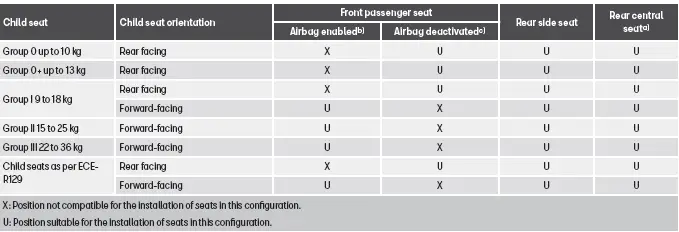
a) Do not install a semi-universal child restraint that uses the vehicle's seat belt together with a support leg in the centre rear seating position. This position does not provide the required conditions for the support leg to stabilise the restraint correctly. Use an approved outer rear seating position or another installation location permitted by the child seat manufacturer.
b) When installing a child restraint on the front passenger seat, move the seat as far away from the front passenger airbag as possible. Check that the upper anchorage point of the vehicle's seat belt remains behind the child restraint so that the belt follows the intended routing. All precautions concerning the front passenger airbag must also be observed, particularly when using a rear-facing child seat.
c) Front passenger seats without height adjustment must be moved to their rearmost position when used for the specified child restraint installation. If the seat has height adjustment, move it to its rearmost and highest position. These adjustments are intended to establish the seating arrangement required for the child restraint, but the manufacturer's installation instructions and the relevant airbag safety precautions must still be followed.
Fitting a child seat using the seat belt
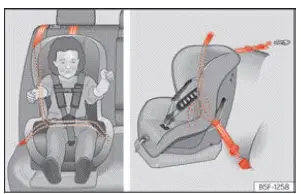
Fig. 40 On rear seats: installing a child seat.
- Position the child restraint on the selected vehicle seat and route the three-point seat belt through the designated guides and openings, exactly as described in the child seat manufacturer's instructions. Make sure the restraint is correctly positioned before fastening the belt, and do not use an alternative belt path that has not been approved for the seat.
- Check the entire visible length of the seat belt to ensure that it is not twisted. The belt must lie flat along its intended route and pass correctly through the child restraint's belt guides. Twisting or incorrect routing can interfere with the secure installation of the seat and reduce the effectiveness of the restraint.
- Insert the seat belt latch plate into the corresponding buckle until an audible click confirms that it has engaged. Check that the buckle is securely fastened and complete any additional belt adjustment required by the child seat manufacturer. Before placing the child in the restraint, verify that the child seat is properly secured and cannot move out of its intended installation position.
WARNING Children must always be secured in the vehicle using a restraint system appropriate for their age, weight and height. An unsuitable or incorrectly installed child seat may fail to provide the required protection during sudden braking or a collision. Never allow a child to travel without the restraint equipment specified for their size.
- Always read and follow all instructions and warnings concerning the installation and use of child restraint systems. Observe both the information provided in the Seat Ateca owner's manual and the instructions supplied by the child seat manufacturer. Check the restraint's installation and the child's seating position before every journey.
 Securing a child seat with the ISOFIX
or i-Size system
The identification and marking of ISOFIX and i-Size anchorage points may vary according to the vehicle's equipment specification and the country in which it is supplied. Before installing a child rest ...

Other materials:
Adjusting the headrests
Fig. 72 Front seat: adjusting the headrest.
Fig. 73 Rear headrest: adjusting the headrest.
Adjusting the height of the headrests
Hold the headrest firmly on both sides with your hands and pull it upwards until it reaches the required height. Raise it gradually so that you can selec ...
Specifications, Description and Operation
SPECIFICATIONS
Material
General Specifications
Torque Specifications
DESCRIPTION AND OPERATION
Wipers and Washers
Overview
The windshield wiper/washer system is activated by the wiper/washer controls
on the multifunction switch. The following functions/features of the windshield
wiper/washer sy ...
Overview and controls
Connect System
Fig. 160 Overview: control unit
Touch screen. The touchscreen is the main interface for operating the Seat Ateca infotainment system. Touch the corresponding icons, menus and on-screen controls to select functions, change settings and access the information displayed. The ...
