
The identification and marking of ISOFIX and i-Size anchorage points may vary according to the vehicle's equipment specification and the country in which it is supplied. Before installing a child restraint, locate the designated attachment points and check the markings provided in the Seat Ateca. Only use anchorage points intended for the selected child seat attachment system.
To determine whether an ISOFIX or i-Size child restraint can be installed in a particular seating position, refer to the compatibility table below. The table identifies the relevant seating positions and approval classifications, helping you establish whether the child seat is suitable for the vehicle. The child restraint manufacturer's instructions and compatibility information must also be taken into account.
Vehicle ISOFIX/i-Size positions
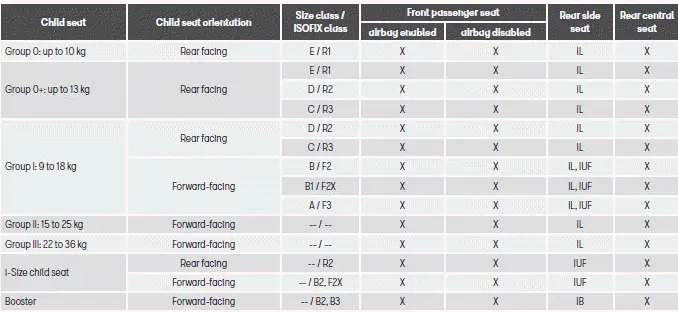
- Size class: The size class identifies the classification assigned to the child restraint under the relevant approval system and is associated with the approved child seat category and weight range. For child seats with universal or semi-universal approval, the size class is indicated on the ECE approval label. The same classification is also specified on the child restraint itself. Check this marking when comparing the child seat with the permitted installation positions shown in the vehicle compatibility table.
- IUF: This designation indicates that the seating position is suitable for ISOFIX or i-Size child restraint systems with universal approval that are authorised for the relevant weight group. The restraint must still be installed using all the attachment components required by its approval, including any specified additional securing strap.
- IL: This designation identifies seating positions suitable for certain ISOFIX child restraints belonging to vehicle-specific, restricted or semi-universal approval categories. Compatibility is not automatic for every restraint within these categories. Consult the child seat manufacturer's approved vehicle list and verify that the Seat Ateca and the intended seating position are included before installation.
- IB: This designation indicates a seating position suitable for an ISOFIX forward-facing group 2/3 booster seat, as well as an i-Size forward-facing child restraint intended for children between 100 and 150 cm in height. The selected restraint must be approved for the child's size and installed using the attachment arrangement specified by its manufacturer.
- X: This designation means that the seating position is not suitable for an ISOFIX or i-Size child restraint in the indicated weight group or size class. Do not install a child seat of that classification in a position marked X. Select a different approved seating position or a suitable child restraint with an authorised installation method.
Securing the child seat with the ISOFIX or i-Size system
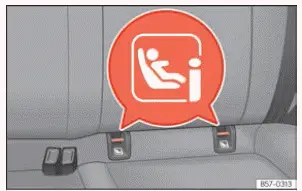
Fig. 36 Rear seat: location of the ISOFIX or
i-Size securing rings.
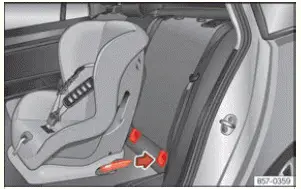
Fig. 37 Rear seats: fitting a child seat with the
ISOFIX system.
Always follow the installation instructions supplied by the child seat manufacturer. Although ISOFIX and i-Size systems are designed to simplify the attachment process, the exact installation procedure can vary between child restraint models. Check the required seating position, connector arrangement and any additional securing components before attempting to install the seat. A child restraint must not be used until all the necessary attachment points have been correctly engaged.
The ISOFIX or i-Size anchorage locations are identified by the corresponding symbols, as illustrated in Fig. 36. The attachment rings are positioned between the rear seat cushion and backrest. Depending on the vehicle design, these rings may be secured to the seat frame or to the rear floor structure. The anchorage points are specifically intended to provide a secure connection between the child restraint and the vehicle, and they must not be used for unrelated purposes.
- Position the child restraint correctly and align its ISOFIX or i-Size connectors with the designated anchorage rings. Push the child seat towards the attachment points until the connectors engage with an audible click, as shown in Fig. 37. Check any locking indicators provided on the child seat to confirm that the connectors are secured. If the restraint requires a Top Tether strap, attach it to the corresponding designated anchorage point and adjust it according to the manufacturer's instructions. Do not leave any required supplementary attachment disconnected.
- Once the child restraint has been installed, firmly pull on both sides of the seat to verify that it is securely anchored. Check that neither ISOFIX connector has disengaged and that the seat remains correctly positioned. If the restraint moves because an attachment has not locked properly, repeat the installation procedure before allowing a child to use it.
Child restraint systems equipped with ISOFIX or i-Size attachments and Top Tether securing arrangements are available through authorised technical service providers. When selecting a seat for the Seat Ateca, confirm that the chosen model is approved for the child's size and the intended installation position. The supplier or child seat manufacturer can provide the relevant compatibility information and instructions for the attachment system.
WARNING The securing rings are designed exclusively for use with child restraint systems equipped with the appropriate ISOFIX or i-Size attachments and, where applicable, the designated Top Tether securing system. These anchorage points must only be used for their intended purpose. Incorrect use can interfere with the secure installation of a child restraint and may result in serious injuries during an accident.
- Never attach child seats that are not equipped with the appropriate ISOFIX or i-Size connectors to the ISOFIX or i-Size anchorage rings. Do not attempt to secure an incompatible restraint using improvised fittings or alternative connections. Only use child seats and attachment systems that are approved for the designated anchorage points and seating position.
 Attachment systems
Different attachment systems are used to install child restraint seats securely, depending on the country and the applicable approval requirements. The Seat Ateca supports approved child seat installa ...
 Top Tether securing belts
Fig. 38 Rear part of the rear seats: securing
rings for the Top Tether belt.
Child restraint systems equipped with a Top Tether attachment have an additional securing strap that connects the ...
Other materials:
Braking system
Information about the brakes
New brake pads require a running-in period before they can deliver their full braking performance. During approximately the first 200 to 300 km, the friction surfaces of the pads and brake discs gradually adapt to one another. Until this process is complete, the braki ...
Traction Control
PRINCIPLES OF OPERATION
The traction control system helps avoid drive wheel spin and loss of
traction.
If your vehicle begins to slide, the system applies the brakes to individual
wheels and, when needed, reduces engine power at the same time. If the
wheels spin when accelerating on slippery ...
Diagnosis and Testing
Seating
Special Tool(s)
Medium Speed Controller Area Network (MS-CAN)
This vehicle utilizes a communication system called a Medium Speed Controller
Area Network (MS-CAN). When diagnosing the memory seat, heated seats or climate
controlled seats, use a Vehicle Communication Module (VCM) and Integr ...
