
Information about the technical specifications
Vehicle identification data
The technical specifications provided for the Seat Ateca may vary according to the model version, engine configuration and optional equipment installed. Differences may also apply to vehicles manufactured for specific markets, special-purpose versions and models fitted with equipment required by the regulations of individual countries. Consequently, not every value listed in this section will necessarily correspond to the exact specification of your vehicle.
The information contained in the vehicle's official documentation always takes precedence over the general technical figures presented in this manual. When confirming specifications for maintenance, registration, loading or other purposes, refer to the documents issued for your particular Seat Ateca.
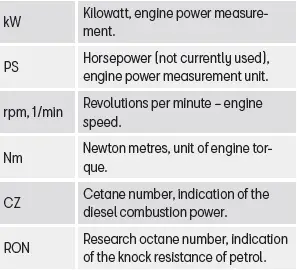
Abbreviations used in the Technical Specifications section
Vehicle Identification Number (VIN)
The Vehicle Identification Number (VIN) is the identification code assigned to your Seat Ateca. It is used to identify the vehicle in official documentation and during servicing or technical enquiries. Depending on where you are checking, the VIN can be located or displayed in several places:
- Infotainment system: Open the vehicle information menu and select Vehicle > Settings > Service. The VIN can be viewed through this function without having to locate the identification markings on the bodywork.
- Windscreen: The VIN is visible through a small inspection window at the lower left-hand side of the windscreen, viewed from the front of the vehicle. This allows the identification number to be checked from outside.
- Vehicle data label: The identification number is also included on the vehicle's data label, together with other information relating to its individual specification.
- Engine compartment: The VIN can be found on the right-hand side of the engine compartment. This location provides another means of checking the vehicle's identification details.
Type plate
The vehicle's type plate is located on the right-hand door frame. It contains manufacturer identification information relevant to the vehicle and its approved specifications. The presence and arrangement of this plate may vary according to the destination market. Seat Ateca vehicles manufactured for certain export countries may not be equipped with a type plate.
Performance
The performance figures stated in the technical specifications represent values applicable under favourable road and weather conditions. They are based on conditions that allow the vehicle to achieve its specified performance without adverse influences from the road surface, weather or other external factors. Actual performance during everyday driving may therefore differ from the published figures.
The stated performance values have been calculated without additional equipment that could influence the vehicle's characteristics. Equipment fitted after manufacture, or items not included in the conditions used to establish the specifications, may affect the results.
For example, accessories installed on the vehicle may alter its weight or aerodynamic characteristics and consequently influence its performance. When comparing published figures with the behaviour of your Seat Ateca, take into account any additional equipment fitted to the vehicle.
Fuel consumption
The officially approved fuel consumption figures are determined from measurements carried out or supervised by certified laboratories within the European Union. These measurements are performed in accordance with the legislation applicable at the time of approval and relate to vehicles with the specified technical characteristics. The prescribed testing procedures provide a standardised basis for establishing and comparing consumption figures. Further information about the relevant European legislation can be obtained from the Publications Office of the European Union through the EUR-Lex website at http://eur-lex.europa.eu/.
The officially determined fuel consumption and CO2 emission values applicable to an individual Seat Ateca are provided in the documentation supplied to the purchaser when the vehicle is bought. These documents should be consulted when precise approved figures are required for the particular vehicle version and equipment configuration.
Actual fuel consumption and CO2 emissions can vary considerably from the approved values. In addition to the engine and equipment fitted to the vehicle, the results depend on driving habits, acceleration and braking patterns, road characteristics, traffic density and environmental conditions. The weight carried by the vehicle, including luggage and passengers, can also influence consumption. For this reason, the figures achieved in normal driving may differ from those measured under standardised approval conditions.
Tank level
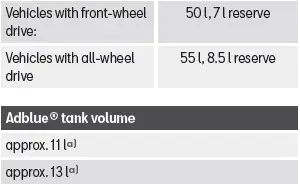
a) The quantity that can actually be added when filling the tank using a fuel dispenser nozzle may be lower than the stated capacity. Under extremely cold conditions, the amount that can be filled may also be reduced. The applicable values depend on the vehicle's equipment and configuration, so the figures shown should be interpreted in relation to the specific Seat Ateca version.
Weights
The specified kerb weight refers to a vehicle prepared for normal driving and includes a driver weighing 75 kg, the necessary operating fluids and, where applicable, the tools and spare wheel supplied with the vehicle. This value represents the vehicle in the condition defined for the technical specifications rather than an empty vehicle without operating equipment. Optional factory-installed equipment and accessories fitted subsequently increase the kerb weight. As the vehicle becomes heavier, the remaining permissible payload decreases accordingly. This must be considered when calculating how much additional weight can be carried in the Seat Ateca without exceeding its authorised limits.
Load on the roof
The maximum authorised roof load for the Seat Ateca is 75 kg. This limit must be respected whenever luggage or other items are carried on the roof. The weight of the roof-mounted equipment and the load being transported must be taken into account when determining the total roof load. Exceeding the permitted value can adversely affect vehicle handling and place excessive stress on the roof-loading arrangement.
Trailer weight
The maximum permitted vertical drawbar load applied to the ball head of the towing bracket is 90 kg. This value represents the maximum downward force that the trailer coupling may exert on the tow ball. When attaching a trailer, the actual drawbar load must remain within this limit and comply with the other towing restrictions applicable to the vehicle and towing equipment. Correct loading of the trailer is important for maintaining stable and predictable handling while towing.
WARNING
Never exceed the maximum authorised weight limits specified for your Seat Ateca. These restrictions apply to the vehicle's permitted loading conditions and must be observed when carrying passengers, luggage, roof loads or towing a trailer. Excessive weight can impair stability, steering and braking performance, increase stress on vehicle components and create a serious risk of an accident. Overloading may also cause damage to the vehicle or its equipment. Always check the relevant weight limits before travelling with a heavy load.
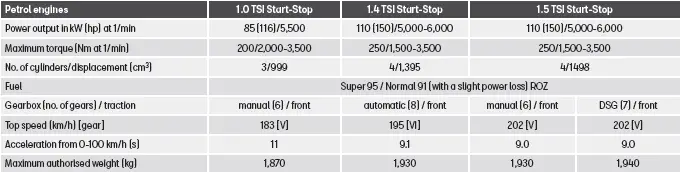
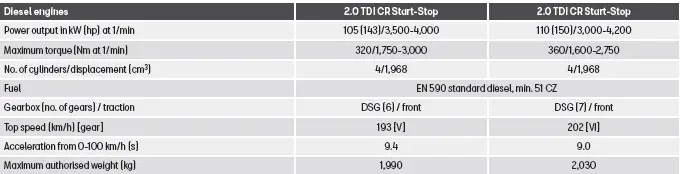
Engine specifications
Dimensions
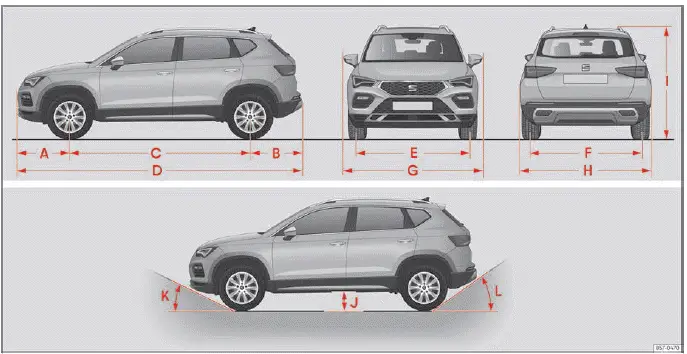
Fig. 234 Dimensions.
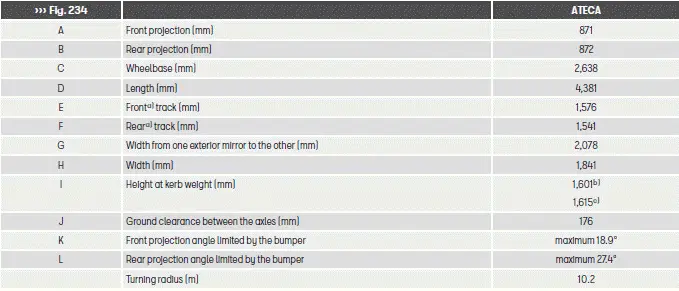
a) The indicated dimension may vary depending on the type of wheel rim fitted to the vehicle. Differences in wheel configuration must therefore be considered when interpreting this measurement for a particular Seat Ateca version.
b) This measurement refers to the distance up to the vehicle's roof. It should be distinguished from measurements that include equipment or components extending above the roof surface.
c) This dimension is measured up to the roof bars. Where roof bars are fitted, their height must be taken into account when determining the overall vehicle height, particularly when assessing clearance beneath entrances, barriers or other overhead obstacles.