
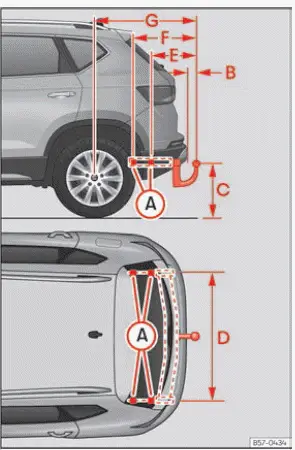
Fig. 185 Towing device: dimensions and
attachment points.
Distance measurements:
- Mounting points on the vehicle: The designated attachment locations for securing the towing bracket to the Seat Ateca. The towing equipment must be fitted using the appropriate mounting points specified for the vehicle.
- 65 mm (minimum): The minimum clearance indicated by measurement B in the towing device installation diagram. This distance must be maintained when fitting the bracket.
- 350 mm to 420 mm (fully laden vehicle): The specified height range for the centre of the tow ball above the road surface when the vehicle is fully loaded, as indicated by measurement C.
- 1043 mm: The installation dimension identified as measurement D in Fig. 185, which must be observed when positioning the towing equipment.
- 413.5 mm: The specified measurement E shown in the towing bracket attachment diagram.
- 633.5 mm: The specified measurement F used in the towing device installation layout.
- 951.5 mm: The specified measurement G indicated in Fig. 185 for the towing bracket mounting arrangement.
SEAT recommends having a towing bracket retrofitted by a specialised workshop rather than attempting the installation independently. Retrofitting may involve more than attaching the bracket to the vehicle's chassis. Depending on the vehicle configuration, modifications to the cooling system or the installation of additional heat protection plates may be necessary to accommodate the towing equipment and the increased demands associated with trailer operation. These requirements must be assessed before installation to ensure that the vehicle remains suitable for towing. SEAT recommends using an authorised SEAT dealership for this work.
Whenever a towing bracket is retrofitted to the Seat Ateca, all specified installation dimensions and clearances must be respected. The measurements shown in ››› Fig. 185 define the required positioning of the towing device and its attachment points. Correct installation is essential for ensuring that the bracket is securely mounted and that the tow ball occupies the intended position relative to the vehicle and the road surface.
The distance between the centre of the tow ball and the road surface, identified by measurement C in ››› Fig. 185, must never fall below the specified minimum. This requirement also applies when the Seat Ateca is fully loaded, including passengers, luggage and the maximum technically permissible vertical load acting on the towing bracket. The vehicle's loaded condition must therefore be considered when checking the installation height. A towing bracket that does not satisfy the required dimensions must not be regarded as correctly installed.
WARNING Incorrectly installed or improperly connected trailer wiring can cause faults throughout the Seat Ateca electronic system. Unsuitable electrical connections may overload circuits, interfere with the operation of vehicle components or damage the electrical equipment. Such malfunctions can create dangerous driving conditions and may result in accidents or serious injuries. All electrical connections associated with a retrofitted towing bracket must be suitable for the vehicle and installed correctly.
- Never connect the trailer's electrical system directly to the wiring or electrical terminals of the vehicle's rear lights, or to any other power source that is not intended for trailer operation. These connections may not be designed to supply the electrical load required by a trailer and can cause damage or malfunctions.
Only use suitable connectors and the designated trailer electrical connection equipment. The wiring must be compatible with the Seat Ateca electrical system and installed according to the applicable technical requirements.
- Have the towing bracket retrofitted only by a specialised workshop. The installation must be carried out using equipment approved for the vehicle, with the correct structural mounting points, electrical connections and required clearances. A qualified workshop can also determine whether additional vehicle-specific measures are necessary before the towing bracket can be used safely.
WARNING If a towing bracket is unsuitable for the vehicle or has been installed incorrectly, it may fail while the Seat Ateca is towing a trailer. A defective or insecure mounting arrangement can allow the trailer to separate from the vehicle during driving, creating an extremely dangerous situation for the occupants and other road users. Such a failure may cause a serious accident and potentially fatal injuries. Only use an approved towing bracket that has been correctly installed and securely attached to the designated vehicle mounting points.
Note
- In accordance with EU Regulation 2021/535, a towing device that cannot be removed or retracted must not be installed where the regulation prohibits such a configuration. The towing equipment must comply with the applicable legal requirements, including those concerning the visibility of the rear registration plate. Check that the selected bracket meets the relevant requirements before installation.
- Only use towing brackets that SEAT has approved for the particular vehicle model. Approval for another vehicle, even one with similar dimensions or construction, does not establish compatibility with the Seat Ateca. The bracket must be appropriate for the specific vehicle version and its authorised towing requirements.
- For certain Seat Ateca versions, installing a conventional towing hook arrangement is not recommended. Vehicle-specific technical characteristics may make an alternative approved towing solution more appropriate.
Consult an authorised Technical Service before selecting or retrofitting a towing bracket. The workshop can advise whether a conventional towing hook is suitable for the particular vehicle version and identify the appropriate approved installation arrangement.
 Installing a rear carrier system or a
bicycle rack on the trailer hitch
Fig. 183 Recommended weight distribution on
the rear carrier system.
Rear carrier systems are accessories mounted on the vehicle's trailer hitch to transport items outside the luggage co ...

Other materials:
Driving with Side Assist
Fig. 127 Control lamp of the lane departure
warning.
Fig. 128 Control lamp of the lane departure
warning.
Connecting and disconnecting
Side Assist can be activated or deactivated through the Assistants menu in the infotainment system or through the instrument cluster d ...
Disassembly
Engine
Special Tool(s)
Material
NOTICE: During engine repair procedures, cleanliness is extremely
important. Any foreign material, including any material created while cleaning
gasket surfaces that enters the oil passages, coolant passages or the oil pan,
can cause engine failure.
NOTE:& ...
Removal and Installation
Headlamp Assembly
Removal
Remove the front bumper cover. Refer to Section 501-19.
Remove the headlamp assembly upper bolt.
To install, tighten to 3.2 Nm (28 lb-in).
Remove the headlamp assembly front bolt.
To install, tighten to 3.2 Nm (28 lb-in).
Remove the headlamp ...
