
The Seat Ateca is equipped with an electronically controlled manual gearbox that combines the operating principles of a manual transmission with the convenience of automatic gear selection. Power from the engine is transmitted to the gearbox through two separate clutches, which work independently to manage the transfer of torque. Unlike a conventional automatic transmission, this dual-clutch arrangement does not use a torque converter. Instead, the two clutches enable the gearbox to change between gear ratios smoothly, helping the vehicle accelerate with minimal interruption to the delivery of engine power. The electronic control system manages gear selection and clutch operation according to the current driving conditions.
The Tiptronic system also allows the driver to select gears manually when greater control over gear changes is desired. By using Tiptronic mode, the driver can choose an appropriate gear for the road conditions rather than relying entirely on automatic selection. This can be particularly useful when driving on winding roads, negotiating gradients or adjusting the vehicle's response to changing traffic conditions. Further information about operating this function is provided in the section on changing gears in Tiptronic mode.
Gear selector positions
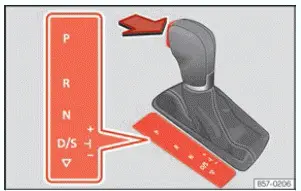
Fig. 98 Selector lever lock.
The current position of the automatic transmission selector lever is indicated by the illumination of the corresponding symbol. This allows the driver to identify the selected transmission range without relying solely on the physical position of the lever. When the selector is in the forward driving positions D or S, or when manual shifting mode M is selected, the instrument cluster also displays the gear currently engaged. The information shown on the display helps the driver monitor the gearbox's operating state and recognise changes in gear selection while driving.
 - Parking lock
When the selector lever is moved into position P, the transmission's parking lock engages and prevents the drive wheels from rotating through the gearbox. This position is intended for use when the vehicle is parked and must only be selected after the Seat Ateca has come to a complete stop. Engaging the parking lock while the vehicle is still moving can place excessive stress on the transmission mechanism. Before leaving the vehicle, make sure it is stationary and correctly secured.
To move the selector lever into position P or release it from P, press and hold the locking button on the selector lever while simultaneously depressing the brake pedal. Both actions are required to operate the selector correctly. Keep the brake pedal pressed until the desired position has been selected, particularly when preparing to move away from a parked position or when the vehicle is standing on a gradient.
 - Reverse gear
Position R engages reverse gear and allows the vehicle to travel backwards. Reverse must only be selected when the Seat Ateca is completely stationary and the engine is running at idle speed. Do not move the selector into R while the vehicle is rolling forwards, even slowly, because the resulting change in transmission operation can place unnecessary mechanical stress on the gearbox. Bring the vehicle to a full stop before selecting reverse.
To engage position R, depress the brake pedal and keep it pressed while holding down the selector lever's locking button. Move the lever into the reverse position only after the vehicle has stopped. When the ignition is switched on and the selector is in R, the reversing lights illuminate automatically. These lights indicate to other road users that the vehicle is prepared to move backwards and also provide illumination behind the vehicle.
 - Neutral
When the selector lever is in position N, the transmission is in neutral and no driving gear is engaged. In this position, the gearbox does not transmit engine power to the drive wheels for forward or reverse movement. Neutral may be used in situations where the transmission needs to be disengaged, but it does not secure the vehicle against rolling. The driver must therefore use the brakes whenever necessary to keep the vehicle stationary.
When the vehicle is stopped or travelling at a speed below 3 km/h (2 mph), the brake pedal must be depressed before the selector lever can be moved from N into the forward driving position D/S. This requirement helps prevent an unintended movement when a driving range is selected. Keep the brake pedal pressed until the gear selection has been completed and you are ready to move off.
 - Permanent forward drive
position
The D/S selector position allows the DSG transmission to operate in either normal driving mode D or Sport mode S. Both settings provide automatic gear selection, but they use different shifting characteristics to suit the driver's preferred driving style. To activate Sport mode, move the selector lever backwards from the normal driving position. Moving the lever backwards again returns the transmission to normal mode D. The currently selected mode is shown on the instrument cluster display, allowing the driver to confirm whether the gearbox is operating in D or S.
In normal driving mode D, the gearbox automatically selects a suitable gear ratio according to the vehicle's operating conditions. Gear selection takes account of engine load, road speed and the Dynamic Regulation Programme (DRP), which helps determine the appropriate shifting behaviour. The transmission adapts its gear changes to the demands placed on the engine, allowing the Seat Ateca to respond to acceleration, steady-speed driving and changes in road conditions without requiring manual gear selection.
Sport mode S is intended for a more dynamic driving style. In this setting, the transmission uses gear ratios that allow greater use of the engine's available power and provide a more responsive driving character. During acceleration, gear changes may be more noticeable than in normal mode because the gearbox is operating with a different shifting strategy. Sport mode is therefore suited to situations where the driver wants a more immediate response from the engine and transmission.
Under certain driving conditions, such as travelling along mountain roads or negotiating a series of bends and gradients, it may be advantageous to switch to Tiptronic mode. Manual gear selection allows the driver to choose a gear that better matches the immediate road conditions, including situations where maintaining a particular gear is preferable to allowing the gearbox to shift automatically. This gives the driver additional control over the transmission's response while retaining the DSG gearbox's electronically controlled clutch operation.
Selector lever lock
The selector lever locking mechanism is designed to prevent an unintended driving range from being selected when the lever is in position P or N. By restricting movement out of these positions unless the required conditions are satisfied, the lock helps reduce the risk of the vehicle moving off unexpectedly. This is particularly important when the engine is running and the driver is preparing to select a forward or reverse gear.
To release the selector lever lock, switch on the ignition and press the brake pedal, keeping it firmly depressed. At the same time, operate the locking button on the selector lever in the direction indicated by the arrow in Fig. 98. Once the lock has been released, the lever can be moved into the required transmission position. Maintain pressure on the brake pedal while completing the selection to ensure that the vehicle remains under control.
When the selector lever is in position P or N, the instrument cluster displays a reminder informing the driver of the action required to release the selector lock. This indication is intended to prevent confusion when the lever cannot be moved directly into a driving position. Follow the displayed instruction and operate the brake pedal and selector locking button as required before selecting the desired gear range.
When stationary, apply foot brake while selecting a gear.
The selector lever lock does not engage when the lever is moved quickly through position N (Neutral), for example when changing directly from R (Reverse) to D (Drive). This allows the driver to alternate between forward and reverse driving ranges without the selector being locked each time it passes through neutral. In certain situations, such as when the Seat Ateca becomes stuck, this feature can assist with carefully rocking the vehicle backwards and forwards to regain traction. However, the selector lock engages automatically if the lever remains in position N for more than approximately one second, the brake pedal is not depressed and the vehicle is travelling at less than 5 km/h (3 mph). Under these conditions, the driver must operate the brake pedal to release the lock before selecting a driving range.
WARNING
- Be particularly careful not to press the accelerator pedal unintentionally while the vehicle is stationary. If a driving range is engaged, the Seat Ateca may begin moving immediately when the accelerator is pressed. This can happen in certain circumstances even when the electronic parking brake is activated. Unexpected vehicle movement can result in a collision, serious injuries or damage to surrounding objects. Keep your foot on the brake pedal whenever the vehicle must remain stationary with the engine running.
- Never move the automatic transmission selector lever into position R (Reverse) or P (Park) while the vehicle is moving. These positions are intended to be selected only when the vehicle has come to a complete stop. Attempting to engage reverse or the parking lock during normal driving can place excessive stress on the transmission and may cause an unexpected reaction from the vehicle.
Failure to observe this instruction may result in serious transmission damage, loss of vehicle control or an accident. Always bring the vehicle to a complete standstill before selecting R or P, and keep the brake pedal depressed while making the selection.
- Whenever the engine is running and the selector lever is in any position other than P, keep the foot brake firmly applied if the vehicle is intended to remain stationary. The DSG automatic transmission can continue transmitting driving force even when the engine is operating at idle speed. As a result, the vehicle may begin creeping forwards or backwards when a driving range is engaged and the brake pedal is released. Do not rely on the engine's low speed to keep the vehicle from moving.
- Never press the accelerator pedal while selecting a transmission range when the vehicle is stationary and the engine is running. Applying engine power during gear selection can cause the vehicle to move unexpectedly as soon as the selected range becomes engaged. Always keep the brake pedal depressed and allow the transmission to complete the selection before accelerating.
Ignoring this precaution can lead to sudden vehicle movement, a collision or serious personal injury. Select the required driving range first, then release the brake and accelerate only when it is safe to move away.
- Never leave the driver's seat while the engine is running and a driving range remains engaged. Before leaving the Seat Ateca, bring it to a complete stop, activate the electronic parking brake and move the selector lever into position P to engage the parking lock. These precautions are necessary to secure the vehicle against unintended movement. Do not leave the vehicle unattended with the engine running, even if you expect to be away for only a short time.
Note
- If the selector lever is accidentally moved into position N while driving, release the accelerator pedal and allow the engine speed to fall to idle before selecting D or S again. Do not immediately re-engage a driving range while the engine is running at an elevated speed. Waiting until the engine has returned to idle helps avoid an abrupt engagement of the transmission and unnecessary stress on the drivetrain. Once the appropriate driving range has been selected, continue driving normally.
- If the electrical power supply to the selector lever is interrupted while the transmission is in position P, the selector lever may remain locked and cannot be moved using the normal procedure. This can occur because the locking mechanism requires electrical power for normal operation. If the lever cannot be released due to a power supply interruption, the manual release mechanism can be used to unlock it. Follow the specified manual release procedure rather than attempting to force the selector lever out of position P.
Note
- If the selector lever lock fails to engage correctly, this indicates a malfunction. In this situation, the transmission interrupts the transfer of driving force to prevent the Seat Ateca from moving unexpectedly. The vehicle may therefore remain stationary even though the driver has attempted to select a driving range. This protective response is intended to reduce the risk of unintended movement while the selector locking mechanism is not operating as required.
To restore normal operation and allow the selector lever lock to engage again, follow the procedure appropriate for the gearbox fitted to the vehicle. The required actions differ between the six-speed and seven-speed DSG transmissions:
- Vehicles with a 6-speed gearbox: Depress the brake pedal and then release it. This action allows the system to attempt to restore the normal operation of the selector lever locking mechanism. Check that the selector responds correctly before attempting to drive away.
- Vehicles with a 7-speed gearbox: Depress the brake pedal and keep the vehicle stationary. Move the selector lever into position P or N, then select the required driving range again. This procedure allows the transmission control system to repeat the gear selection process and attempt to restore normal engagement.
- If a driving range has been selected but the vehicle does not move forwards or backwards as expected, do not repeatedly press the accelerator pedal in an attempt to force the vehicle to move. The selected gear may not have engaged correctly, or the transmission may be experiencing a malfunction. Keep the vehicle under control with the brake pedal and proceed according to the following instructions:
- If the Seat Ateca does not move in the intended direction, the transmission control system may not have engaged the selected gear ratio correctly. Depress the brake pedal, keep the vehicle stationary and select the required driving range again. Allow the transmission to complete the selection before attempting to move off. This may restore normal operation if the original gear engagement was incomplete.
- If the vehicle still does not move in the selected direction after the gear range has been reselected, a malfunction of the transmission system may be present. Do not continue attempting to move the vehicle by applying additional accelerator pressure, as the gearbox may not be operating correctly.
Seek assistance from a qualified specialist and have the DSG transmission and its associated control system inspected. The cause of the malfunction must be identified and corrected before normal vehicle operation can be considered reliable. If the transmission does not respond correctly to the prescribed procedure, professional diagnosis is necessary.

 Changing gear in Tiptronic mode
Fig. 99 Lever in the Tiptronic position
Fig. 100 Steering wheel: automatic gearbox
levers
Tiptronic allows the driver to change gears manually while retaining the convenience of the DSG ...
Other materials:
Basic version digital instrument cluster
Fig. 1 Basic version digital instrument cluster: Main
view.
The upper section of the digital instrument cluster displays information such as the current time, selected driving profile, engine speed and outside temperature. The lower section provides additional driving information, including ...
Steering
Electric Power Steering
WARNING: The electric power steering system has diagnostic
checks that continuously monitor the system to ensure proper
operation. When a system error is detected a steering message will
appear in the information display.
WARNING: The electric power steering system has d ...
Capacities and Specifications
Engine Drivebelt Routing
3.5L V6 engine
3.5L V6 SHO engine
2.0L EcoBoost engine
...
