
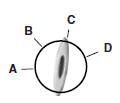
A. Off: The ignition is off.
Note: When you switch the ignition off and leave your vehicle, do not leave your key in the ignition. This could cause your vehicle battery to lose charge.
B. Accessory: Allows the electrical accessories, such as the radio, to operate while the engine is not running.
Note: Do not leave the ignition key in this position for too long. This could cause your vehicle battery to lose charge.
C. On: All electrical circuits are operational and the warning lamps and indicators illuminate.
D. Start: Cranks the engine.
KEYLESS STARTING (IF EQUIPPED)
Note: The keyless starting system may not function if the key is close to metal objects or electronic devices such as cellular phones.
Note: A valid key must be located inside your vehicle to switch the ignition on and start the engine.
Note: When locking your vehicle, any remote controls left inside the vehicle may become disabled. A message may appear in the information display indicating that there is no key detected if you try to start the engine. Press the unlock button on the remote control to enable it, and then start the engine.
Ignition Modes
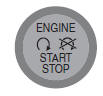
Off: Turns the ignition off.
• Without applying the brake pedal, press and release the button once when the ignition is in the on mode, or when the engine is running but the vehicle is not in motion.
Accessory: Allows some electrical accessories to operate while the engine is not running.
• Without applying the brake pedal, press and release the button once.
On: All electrical circuits are operational. Warning lamps and indicators are illuminated.
• Without applying the brake pedal, press and release the button once from accessory mode.
• Without applying the brake pedal, press and release the button twice from off mode.
Start: Starts the engine.
• Press the brake pedal, and then press the button for any length of time. An indicator light on the button illuminates when then ignition is on and when the engine starts.
 Starting and Stopping the Engine
GENERAL INFORMATION
WARNING: Extended idling at high engine speeds can produce
very high temperatures in the engine and exhaust system,
creating the risk of fire or other damage.
WARNING: Do not p ...
 Starting a gasoline engine
When you start the engine, the idle speed increases, this helps to warm
up the engine. If the engine idle speed does not slow down automatically,
have your vehicle checked by an authorized dealer.
...
Other materials:
General Procedures
Air Conditioning (A/C) Clutch Air Gap Adjustment
Check the A/C clutch air gap at 3 equally spaced places between the
clutch plate and the A/C clutch pulley.
Remove the clutch plate. Add or remove spacers between the clutch plate
hub and the compressor shaft until the clearance is within ...
Specifications, Description and Operation, General Procedures
SPECIFICATIONS
Material
General Specifications
Torque Specifications
a Tighten to 10 Nm (89 lb-in) plus an additional 720 degrees.
b Tighten to 16 Nm (142 lb-in) plus an additional 180 degrees.
c Refer to the procedure in this section.d Tighten to 5 Nm (44 lb-in) plus a ...
Fuel Charging and Controls - Turbocharger, 3.5L GTDI
SPECIFICATIONS
Material
Torque Specifications
a Refer to the procedure in this section.
DESCRIPTION AND OPERATION
Turbocharger
NOTICE: Whenever turbocharger air intake system components are
removed, always cover open ports to protect from debris. It is important that no
foreign materia ...
