
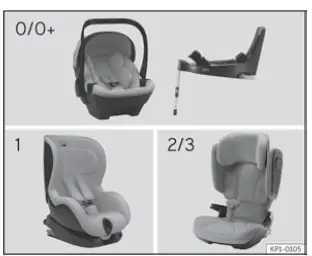
Fig. 33 Examples of child seats.
Only use child restraint systems that have received official approval and are appropriate for the child who will use them. The selected seat must correspond to the child's height and weight and must be suitable for installation in the intended seating position of the Seat Ateca. An approved child seat can only provide its intended protection when it is installed correctly and used within the limits specified by its manufacturer.
Child restraint systems are approved under the ECE-R44 or ECE-R129 regulations. The abbreviation ECE-R refers to regulations issued under the framework of the United Nations Economic Commission for Europe. These standards establish requirements for the approval and classification of child restraints, including the criteria used to determine which children may use a particular seat.
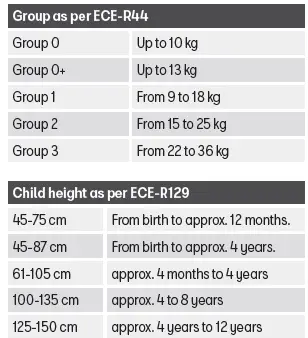
Child seats by weight group as per ECE-R44 and height as per ECE-R129
Under the ECE-R44 classification, child restraint systems are divided into five weight groups, allowing seats to be selected according to the child's body weight. The ECE-R129 standard instead uses the child's height as a principal classification criterion. When choosing a child seat, check the approval label and the manufacturer's specified limits rather than relying solely on the child's age. The different categories are illustrated in the following classification information.
Child seats tested and approved in accordance with ECE-R44 or ECE-R129 carry the corresponding official approval marking. This label identifies the regulation under which the restraint was approved and includes an approval symbol consisting of the letter E inside a circle, together with the relevant approval number. Before purchasing or installing a child seat, examine its approval label to confirm that it meets the applicable requirements and is suitable for the intended use.
When installing and using any child restraint, follow the manufacturer's instructions without deviation and observe the statutory requirements in the country concerned. The installation method may differ according to the restraint's approval category, the child's size and the attachment systems available in the vehicle. Incorrectly routed seat belts, improperly secured ISOFIX connectors or incorrectly adjusted additional restraints can compromise the protection provided by an otherwise approved child seat.
It is advisable to keep the manufacturer's Child Seat Instruction Manual with the Seat Ateca's on-board documentation at all times. The instructions provide the information needed to install, remove and adjust the restraint correctly, including details of any specific attachment requirements or restrictions. They should be consulted whenever the child seat is moved to another seating position or its configuration is changed.
SEAT recommends child restraint systems available through the Original Accessories Catalogue. These seats have been designed and tested for use in SEAT vehicles, helping owners select suitable equipment for their particular model. A SEAT dealer can provide information about available child seats and help identify an appropriate restraint for the child's age group and physical size. Compatibility with the Seat Ateca and the intended seating position should always be confirmed before installation.
Child seats by approval category
Child restraint systems may be approved in different categories, depending on the installation requirements and the range of vehicles in which they are permitted to be used. Under ECE-R44, the relevant categories include universal, semi-universal and vehicle-specific approval. The ECE-R129 regulation also establishes the i-Size approval category. Understanding these classifications is important because an approved child seat is not necessarily suitable for every vehicle or seating position.
- Universal: Child seats with universal approval are intended for installation in vehicles that meet the applicable requirements for this category. A separate vehicle model compatibility list is not required for this type of approval. However, the restraint must still be installed using the attachment method specified by its manufacturer, and the chosen seating position must be suitable. In the case of universal ISOFIX approval under the relevant ECE-R44 classification, the child seat is additionally equipped with a Top Tether strap. This strap must be attached to the designated anchorage point and adjusted correctly as part of the installation.
- Semi-universal: Child seats with semi-universal approval must meet the relevant general approval requirements but also use additional securing or support devices that require specific testing. Because these components may depend on the vehicle's design and available installation points, compatibility cannot be assumed for every model.
Manufacturers of semi-universal child seats provide a list identifying the vehicle models and, where applicable, the seating positions in which the restraint may be installed. Before using such a seat in the Seat Ateca, consult the manufacturer's compatibility list and confirm that the vehicle and intended installation position are included. The child seat must then be installed exactly as described in its instructions.
- Vehicle-specific: A child restraint with vehicle-specific approval is tested dynamically for individual vehicle models rather than being approved for general installation across all vehicles. This approval takes account of the particular vehicle application for which the restraint has been tested. Manufacturers supply a compatibility list identifying the models in which the seat is approved for use. A vehicle-specific child seat should only be installed in the Seat Ateca if the relevant model and seating position are included in the manufacturer's approved applications.
- i-Size: Child seats carrying i-Size approval must comply with the installation and safety requirements established by the ECE-R129 regulation. This classification uses height-based criteria and defines requirements intended to support correct restraint selection and installation. Compatibility depends on the approval of the child seat and the suitability of the vehicle's seating position. Child restraint manufacturers can provide information about which i-Size seats are approved for use in the Seat Ateca and explain any installation conditions that must be observed.
 Introduction
For safety reasons, and based on findings from accident statistics, SEAT recommends that children under 12 years of age travel in the rear seats. Depending on their age, height and weight, children mu ...
 Fitting and using child seats
Fig. 34 Airbag sticker: on the passenger side
sunshade blind.
Fig. 35 Airbag sticker: on the rear frame of the
passenger side door.
Warnings about fitting a child seat
Before i ...
Other materials:
Parallel parking
Fig. 145 Display on the Infotainment System
display: reverse assistant, mode 2.
Find a parking space. Identify a suitable parallel parking space along the road. Check that the space is large enough for the Seat Ateca and that the surrounding vehicles or objects leave sufficient room ...
Four Wheel Drive (4WD) Systems
DESCRIPTION AND OPERATION
All Wheel Drive (AWD) Systems
The AWD system consists of the following:
PTU
Rear driveshaft
AWD relay module
Rear axle with ATC solenoid
Torque from the engine is transferred through the transmission to the PTU.
This torque is transferre ...
Child restraint and safety belt maintenance
Inspect the vehicle safety belts and child safety seat systems periodically
to make sure they work properly and are not damaged. Inspect the
vehicle and child seat safety belts to make sure there are no nicks, tears
or cuts. Replace if necessary. All vehicle safety belt assemblies, including
ret ...
