
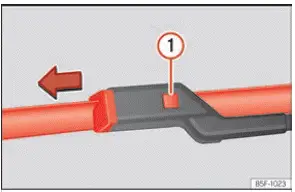
Fig. 191 Changing the windscreen wiper
blades
The windscreen wiper blades fitted to the Seat Ateca are supplied with a graphite coating on their wiping surfaces. This coating helps the rubber move smoothly across the glass and reduces the noise produced during operation. When the graphite layer becomes worn or damaged, the blades may no longer glide evenly over the windscreen. As a result, wiping can become noticeably noisier, particularly when the blades move across a wet surface.
Inspect the condition of the windscreen wiper blades regularly, paying attention to the rubber edges, the quality of the wiping action and any unusual noises. The blades are exposed to weather, dirt and repeated movement across the glass, so their condition can deteriorate with use. Regular inspection helps identify problems before they significantly affect visibility.
If the wiper blades scrape, judder or make excessive noise while moving across the windscreen, determine whether the problem is caused by dirt or by damage to the blade. Dirty blades should be cleaned carefully using a suitable soft cloth, while blades with damaged or deteriorated wiping edges should be replaced. A blade that no longer maintains proper contact with the glass may leave streaks or areas of water behind.
If cleaning or replacing the wiper blades does not restore satisfactory operation, the angle at which the wiper arms contact the windscreen may be incorrect. An improperly aligned arm can prevent the blade from moving smoothly across the glass, even when the rubber itself is in good condition. Have the wiper arm alignment inspected by a specialised workshop and adjusted if necessary. Do not attempt to correct the angle by forcibly bending the arm.
Damaged windscreen wiper blades should be replaced without delay. Worn or torn rubber can reduce the driver's view through the windscreen, particularly during heavy rain or when road spray is present. Suitable replacement blades are available from qualified workshops. When selecting replacements for the Seat Ateca, make sure they have the correct length, attachment design and compatibility with the vehicle's wiper arms.
Raising and lowering windscreen wiper arms
- Move the front windscreen wipers into their service position before lifting the arms. Follow the procedure described above and confirm that the wipers have reached the correct position. This provides the clearance needed to raise the arms without interfering with the bonnet.
- When lifting or lowering a wiper arm, hold it at the blade attachment point rather than pulling on the rubber wiping element. Move the arm carefully and keep it under control throughout the operation. Avoid allowing the arm to spring back against the glass, as the impact could damage the windscreen.
Cleaning the windscreen wiper blades
- Raise the wiper arms carefully after placing the front wipers in their service position. Make sure the blades are free to move and are not stuck to the glass by ice or other deposits.
- Use a soft, clean cloth to wipe dust, road dirt and other deposits from the rubber wiping edges. Clean the blades gently along their length without applying excessive pressure or pulling the rubber away from its support. Removing accumulated dirt can help restore smooth and quiet wiping.
- If the blades are heavily soiled, clean them using a soft sponge or a damp cloth. Work carefully to remove stubborn deposits without damaging the graphite coating. Avoid abrasive materials or aggressive cleaning products, as these may shorten the service life of the blades.
Changing the windscreen wiper blades
- Move the wipers into their service position, then carefully lift and unfold the wiper arms away from the windscreen. Support each arm securely while working to prevent it from falling back against the glass.
- Press and hold the release button marked 1 in ››› Fig. 191. While keeping the button depressed, gently slide the wiper blade in the direction indicated by the arrow to disengage it from the arm. Do not twist the attachment or use excessive force, as this could damage the retaining mechanism.
- Position a new wiper blade of the same length and attachment design on the wiper arm. Slide it into the mounting point until it engages securely. Check that the blade is correctly fitted and cannot come loose during operation. Replacement blades must be compatible with the Seat Ateca wiper arm design.
- Carefully lower the wiper arms until the new blades rest against the windscreen. Make sure both blades are properly positioned and that the arms are not twisted or obstructed. Once the arms have been lowered, return the wipers to their normal resting position using the wiper lever.
 Wiper service position
Fig. 190 Wipers in service position.
Before moving the windscreen wipers into their service position, make sure that the wiper blades are not frozen to the glass. If ice has formed around t ...
 Changing the rear window wiper blade
Fig. 192 Changing the rear wiper blade
Carefully lift the rear window wiper arm away from the glass. Hold the arm securely while preparing to remove the blade, and avoid placing unnecess ...
Other materials:
Using snow chains
Your Taurus SHO may be equipped with summer tires to provide
superior performance on wet and dry roads. Summer tires do not have
the Mud and Snow (M+S or M/S) tire traction rating on the tire side
wall. Since summer tires do not have the same traction performance as
All-season or Snow tires, For ...
Introduction
Predictive speed adjustment is designed to adapt the Seat Ateca's driving speed according to detected speed limits and the layout of the road ahead. The function takes account of relevant road features, including bends, intersections and roundabouts, and can adjust the programmed speed in anticipati ...
Adjusting the exterior mirrors
Fig. 87 Driver's door detail: exterior mirror
control.
The exterior mirrors of the Seat Ateca are adjusted using the rotary control located on the driver's door, as illustrated in Fig. 87. Turn the control to the position corresponding to the function you want to use. Depending on the veh ...
