
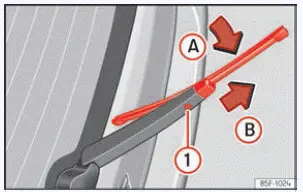
Fig. 192 Changing the rear wiper blade
- Carefully lift the rear window wiper arm away from the glass. Hold the arm securely while preparing to remove the blade, and avoid placing unnecessary pressure on the rear window or the wiper mechanism.
- Rotate the rear wiper blade slightly in the direction indicated by arrow A in ››› Fig. 192. This movement positions the blade so that it can be released from its attachment point. Do not force the blade beyond the movement required for removal.
- Press and hold release button 1 while gently pulling the blade in the direction indicated by arrow B. Keep the button depressed until the blade disengages from the wiper arm. Remove the blade carefully to avoid damaging the attachment mechanism.
- Fit a new rear wiper blade of the same length and type by inserting it into the wiper arm in the direction opposite to arrow B. Push it into place until release button 1 engages with an audible or noticeable click. Check that the new blade is securely attached before lowering the arm.
- Carefully fold the rear wiper arm back towards the window and allow the blade to rest against the glass. Make sure the blade lies correctly against the rear window and that its movement is not obstructed.
WARNING Worn, damaged or dirty windscreen wiper blades can significantly reduce visibility, particularly during rain, snowfall or when water and dirt are thrown onto the glass by other vehicles. Blades that leave streaks, skip across the surface or fail to clear water properly may prevent the driver from seeing road markings, obstacles and other traffic in time. Poor visibility increases the risk of accidents and serious injuries.
- Always replace windscreen wiper blades that are damaged, excessively worn or no longer clean the glass effectively. Do not continue using blades with torn rubber, defective attachments or persistent wiping problems that cannot be corrected by cleaning. Both the front and rear wipers should be maintained in a condition that provides adequate visibility whenever they are needed.
NOTICE
- Damaged or dirty wiper blades can scratch the glass as they move across it. Dirt particles trapped against the wiping edge may be dragged over the surface, while damaged rubber may fail to protect the glass from contact with harder parts of the blade assembly. Keep the blades clean and replace them when necessary to prevent avoidable damage to the windscreen or rear window.
- Do not clean the wiper blades with solvent-based products, abrasive sponges or sharp objects. These can damage the graphite coating applied to the rubber and may also harm the wiping edge itself. Once the coating has deteriorated, the blades may become noisier and less effective. Use only soft cleaning materials and avoid scraping deposits from the rubber with hard implements.
- Never use petrol, nail varnish remover, paint thinner or similar chemical products to clean the vehicle's windows or wiper blades. Such substances may damage rubber components, surface coatings and other materials around the glass. Use suitable automotive glass-cleaning products and gentle cleaning methods instead.
- In freezing conditions, always check whether the wiper blades have become frozen to the glass before switching on the wipers. Operating the system while the blades are stuck can damage the rubber, wiper arms or drive mechanism. During cold weather, leaving the front wipers in their service position while the vehicle is parked may make it easier to prevent ice from forming around the blades or to fit a windscreen cover.
NOTICE
- To prevent damage to the bonnet and windscreen wiper arms, only raise the front wiper arms when they have been moved into the designated service position. Attempting to lift them from their normal resting position may cause contact with the bonnet edge and damage the paintwork or wiper components. Always use the prescribed procedure before cleaning or replacing the front blades.
- Before driving, always lower the wiper arms carefully so that the blades rest correctly against the glass. Never operate the wiper system while the arms are raised away from the windscreen. After completing maintenance, return the front wipers to their normal resting position and ensure that all blades are securely attached and ready for use.
 Changing the wiper rear wiper
blades
Fig. 191 Changing the windscreen wiper
blades
The windscreen wiper blades fitted to the Seat Ateca are supplied with a graphite coating on their wiping surfaces. This coating helps the r ...
 Jump start
...
Other materials:
Driving with a loaded vehicle
Carrying passengers, luggage or other heavy items changes the way a vehicle responds to steering, acceleration and braking. Additional weight can affect stability, increase braking distances and alter the vehicle's handling, particularly when cornering or making sudden manoeuvres. To maintain safe a ...
Heated and ventilated seats
Heated Seats
WARNING: Persons who are unable to feel pain to the skin
because of advanced age, chronic illness, diabetes, spinal cord
injury, medication, alcohol use, exhaustion, or other physical conditions,
must exercise care when using the seat heater. The seat heater may
cause burns even at ...
Fuel Tank and Lines
SPECIFICATIONS
General Specifications
Torque Specifications
DESCRIPTION AND OPERATION
Fuel Tank and Lines
2.0L Gasoline Turbocharged Direct Injection (GTDI)
Fuel Tank and Lines
The fuel tank and lines consists of:
a single container (L-shaped) fuel tank.
a fuel level sensor assembly.
a Fuel ...
