
Sun blind
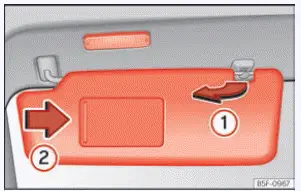
Fig. 88 Sun visor
Options for adjusting driver and front passenger sun visors
- Lower the sun visor towards the windscreen to reduce glare from sunlight entering through the front of the vehicle. Position the visor so that it shields your eyes without unnecessarily obstructing your view of the road, traffic signals or surrounding vehicles.
- The sun visor can be released from its retaining clip and rotated towards the side window, as illustrated by position 1 in Fig. 88. This allows the visor to provide protection against sunlight entering from the side rather than directly through the windscreen.
- Once the sun visor has been moved towards the door, it can be swung backwards and adjusted lengthwise to provide more suitable coverage along the side window. Select a position that reduces glare while preserving a clear view of the road and surrounding traffic.
Each sun visor is equipped with a vanity mirror concealed behind a cover. Opening the cover, indicated by position 2 in Fig. 88, automatically switches on the associated mirror light. This provides illumination around the vanity mirror, making it easier to use when the passenger compartment is not brightly lit.
The vanity mirror light switches off automatically when the cover is closed or when the sun visor is returned to its raised position against the headliner. This prevents the light from remaining illuminated unnecessarily after the mirror is no longer being used.
WARNING Sun blinds and sun visors can obstruct the driver's field of vision if they are positioned incorrectly. A visor left extended when it is not needed may conceal traffic signs, pedestrians, approaching vehicles or other important parts of the surrounding road environment. Restricted visibility increases the risk of an accident.
- Always return sun blinds and sun visors to their designated stowed positions when they are not required. When using a visor to reduce glare, adjust it carefully so that it does not interfere with the driver's ability to observe the road and surrounding traffic.
Note Under certain operating conditions, the light associated with the sun visor switches off automatically after a few minutes, even if it has not been switched off manually. This automatic shut-off function helps prevent unnecessary electrical consumption and reduces the risk of discharging the vehicle's battery when the vanity mirror light has been left on.
 Adjusting the exterior mirrors
Fig. 87 Driver's door detail: exterior mirror
control.
The exterior mirrors of the Seat Ateca are adjusted using the rotary control located on the driver's door, as illustrated in Fig. 87. ...
 Air conditioning
...
Other materials:
Addresses of the manufacturers
The following section provides contact details for manufacturers of components that may be installed in the Seat Ateca. These addresses are included where required by law, particularly for components whose size, design or physical characteristics do not allow the manufacturer's identification inform ...
Rear Drive Halfshafts
SPECIFICATIONS
Torque Specifications
a Refer to the procedure in this section.
DESCRIPTION AND OPERATION
Rear Drive Halfshafts
The halfshafts consist of the following components:
Inner CV joints
Outer CV joints
Interconnecting shafts
The halfshafts are splined on the outboard stub s ...
Fuses inside the vehicle
Fig. 200 On the dash panel on the driver side:
fuse box cover.
Fig. 201 Right-hand drive vehicles: fuse box
cover under the passenger side dash panel.
The interior fuse box is accessed differently depending on whether the Seat Ateca has left-hand or right-hand drive. Before a ...
