
WARNING:
To help avoid personal injury, please read and understand the limitations of the system as contained in this section. Sensing is only an aid for some (generally large and fixed) objects when moving in reverse on a flat surface at parking speeds.
Traffic control systems, inclement weather, air brakes, and external motors and fans may also affect the function of the sensing system; this may include reduced performance or a false activation.
WARNING:
To help avoid personal injury, always use caution when in R (Reverse) and when using the sensing system.
WARNING:
This system is not designed to prevent contact with small or moving objects. The system is designed to provide a warning to assist the driver in detecting large stationary objects to avoid damaging the vehicle. The system may not detect smaller objects, particularly those close to the ground.
WARNING:
Certain add-on devices such as large trailer hitches, bike or surfboard racks and any device that may block the normal detection zone of the system, may create false beeps.
Note:
Keep the sensors (located on the bumper/fascia) free from snow, ice and large accumulations of dirt. If the sensors are covered, the system’s accuracy can be affected. Do not clean the sensors with sharp objects.
Note:
If your vehicle sustains damage to the bumper/fascia, leaving it misaligned or bent, the sensing zone may be altered causing inaccurate measurement of obstacles or false alarms.
The sensing system warns the driver of obstacles within a certain range of the bumper area. The system turns on automatically whenever the ignition is switched on.
When receiving a detection warning, the radio volume is reduced to a predetermined level. After the warning goes away, the radio volume returns to the previous level.
The system can be turned off using the information display control.
Refer to the Information Display chapter.
If a fault is present in the system, a warning message appears in the information display and does not allow the driver to switch the faulted system on.
Note: If your vehicle is equipped with MyKey®, it is possible to prevent turning the sensing system off. Refer to the MyKey® chapter.
Using the Rear Sensing System
The rear sensors are only active when the transmission is in R. As the vehicle moves closer to the obstacle, the rate of the audible warning increases. When the obstacle is fewer than 12 inches (30 centimeters) away, the warning sounds continuously. If a stationary or receding object is detected farther than 12 inches (30 centimeters) from the side of the vehicle, the tone sounds for only three seconds. Once the system detects an object approaching, the warning sounds again.
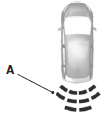
A. Coverage area of up to 6 feet (2 meters) from the rear bumper (with a decreased coverage area at the outer corners of the bumper).
The system detects certain objects while the transmission is in R: • and moving toward a stationary object at a speed of 3 mph (5 km/h) or less.
• but not moving, and a moving object is approaching the rear of the vehicle at a speed of 3 mph (5 km/h) or less.
 Parking Aids
...
 Active park assist
WARNING: This system is designed to be a supplementary park
aid. It may not work in all conditions and is not intended to
replace the driver’s attention and judgment. The driver is responsible
fo ...
Other materials:
Fuel quality
Note: Use of any fuel other than those recommended may cause
powertrain damage and a loss of vehicle performance; repairs may not be
covered under warranty.
Choosing the Right Fuel (Gasoline Engines)
Use only UNLEADED gasoline or UNLEADED gasoline blended with a
maximum of 15% ethanol in your g ...
Audio System
GENERAL INFORMATION
Radio Frequencies and Reception Factors
AM and FM frequencies are established by the Federal Communications
Commission (FCC) and the Canadian Radio and Telecommunications
Commission (CRTC). Those frequencies are:
AM: 530, 540–1700, 1710 kHz
FM: 87.9–107.7, 107.9 MHz
...
Removal and Installation
Generator - 2.0L GTDI
Removal
Disconnect the battery. For additional information, refer to Section
414-01.
Remove the upper Charge Air Cooler (CAC) pipe. For additional
information, refer to Intake Air System Components - Exploded View
in Section 303-12.
...
