
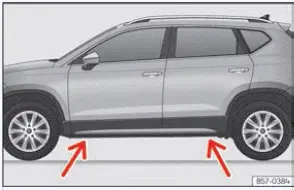
Fig. 226 Jack position points.
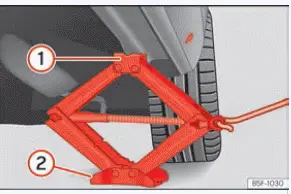
Fig. 227 Crossbar: mounting the jack on the vehicle.
- Place the jack supplied with the vehicle's on-board tools on firm, stable ground. The supporting surface must be capable of carrying the vehicle's weight without allowing the jack to sink, tilt or move unexpectedly.
If the ground is not sufficiently firm, position a large, strong board or another suitable rigid support beneath the jack to distribute the load more effectively. When working on a smooth or slippery surface, such as tiles, place a rubber mat or an equivalent non-slip material beneath the jack to help prevent its base from sliding. Check that the supporting material remains stable before beginning to lift the vehicle.
- Locate the designated jack support point on the lower body sill nearest to the wheel that needs to be changed. The position is identified by a marking or recessed section in the sill area, as illustrated in Fig. 226. Only use the specified support point, since other sections of the bodywork may not be designed to withstand the lifting force.
- Position the jack directly beneath the selected support point and begin turning its crank handle. Raise the upper part of the jack gradually until the locating tab marked 1 in Fig. 227 is positioned immediately below the corresponding recess or mounting area provided on the vehicle. Do not begin lifting the vehicle until the jack is correctly aligned.
- Adjust the jack so that the upper locating tab 1 engages securely with the designated support area on the body sill. At the same time, make sure the movable jack base marked 2 rests fully and evenly on the ground. The base plate 2 must be positioned vertically beneath the upper support point 1 so that the lifting force is applied in the intended direction. Check that the jack cannot slip sideways and that its upper contact point remains correctly engaged.
- Once the jack is properly positioned and stable, continue turning the crank handle slowly until the wheel being changed is raised just clear of the ground. Lift the vehicle only as far as necessary to remove and install the wheel. Avoid raising it unnecessarily high, as this can reduce stability and increase the consequences of any movement of the jack.
WARNING The jack supplied with the Seat Ateca is designed specifically for emergency wheel changes on this vehicle model. It must not be used to lift heavier vehicles, other types of vehicles or unrelated loads. Using the jack outside its intended purpose may cause it to become unstable, collapse or fail, creating a serious risk of injury.
- Always make sure that the jack is positioned securely and remains stable throughout the lifting procedure. On slippery ground, the base may slide out of position, while on soft or unstable surfaces it may sink into the ground. Either situation can cause the vehicle to fall from the jack and result in serious injuries.
- Only use the factory-supplied jack intended for the Seat Ateca when carrying out the wheel-changing procedure described here. Other jacks, including those approved for different SEAT models, may have unsuitable support surfaces or lifting characteristics and could slip from the vehicle's designated lifting point.
- Position the jack exclusively at the reinforced support points provided on the lower body sill and ensure that it is correctly aligned with the designated mounting area. If the jack is placed elsewhere or its locating tab does not engage properly, it may not have sufficient support and could slip while the vehicle is being raised. This presents a serious risk of injury.
- Never place your hands, arms, legs or any other part of your body beneath a vehicle that is supported only by the jack. The jack is intended for temporary lifting during a wheel change and does not provide the secure support required for working underneath the vehicle.
- If work underneath the vehicle is necessary, the vehicle must also be supported by suitable, correctly positioned support stands designed for that purpose. Never rely on the jack alone to hold the vehicle above you, as an unexpected movement or failure could cause it to fall.
- Do not attempt to raise the vehicle if it is leaning significantly to one side or is otherwise unstable. The engine must also be switched off before lifting begins. Raising an unstable vehicle or one with its engine running increases the risk of movement and loss of support.
- Never start the engine while the vehicle is raised on the jack. Engine operation can produce vibrations and movement that may disturb the jack's position or cause the vehicle to slip from its support. The engine must remain switched off until the vehicle has been safely lowered onto the ground.
NOTICE
- Do not position the jack against an arbitrary section of the lower body sill or crossbar. The vehicle must only be raised at the designated reinforced support points, with the jack correctly aligned and its locating tab properly engaged.
Applying the lifting force to an unsuitable area can deform or damage the body structure, sill panels or surrounding components. Incorrect jack placement may also damage the vehicle even if the lifting operation appears to proceed normally.
- Do not apply excessive loads to the external body trim or door areas. Standing on these components, positioning the jack beneath them, resting heavy objects against them or otherwise using them as load-bearing surfaces may cause scratches, deformation or structural damage. These exterior parts are not intended to support the vehicle's weight or other substantial loads. SEAT accepts no responsibility for damage resulting from improper use of the exterior trim or bodywork.
 Loosening wheel nuts
Place the socket end of the wheel wrench fully over the wheel nut or bolt head, as shown in Fig. 224. Check that the tool is seated squarely and securely before applying force, since incomplete eng ...
 Removing and installing a wheel
Once the wheel bolts have been loosened and the Seat Ateca has been safely raised using the jack, the damaged wheel can be removed and replaced. Before proceeding, make sure the vehicle is stable, the ...
Other materials:
Driving through water
WARNING: Drive through water in an emergency only, and not
as part of normal driving.
WARNING: Engine damage can occur if water enters the air
filter.
Note: Driving through deep water may allow water into the transmission
or air intake and can cause internal vehicle damage or cause it to stall. ...
Booster seats
WARNING: Never place, or allow a child to place, the shoulder
belt under a child’s arm or behind the back because it reduces
the protection for the upper part of the body and may increase the risk
of injury or death in a crash.
Use a belt-positioning booster seat for children who have outgrown ...
Body Closures
SPECIFICATIONS
Torque Specifications
GENERAL PROCEDURES
Door Adjustment - Front
Loosen the front door hinge-to-front door bolts until the front door is
able to move slightly.
Align the front door.
Align the front door body angles to the rear door.
Be sure that the front door is flush ...
