
Environmental compatibility
Environmental protection is an important consideration throughout the development and production of SEAT vehicles. From the initial design of individual components to the selection of materials and manufacturing processes, attention is given to reducing environmental impact and improving the possibilities for recovering and recycling materials at the end of a vehicle's service life. These principles are reflected in the design and production of the Seat Ateca.
Constructive measures to encourage recycling
- Connections designed for easier dismantling: Joints and fastening arrangements are developed with consideration for the removal and separation of components. This can simplify dismantling operations when the vehicle reaches the end of its useful life and facilitate the recovery of individual materials.
- Modular construction: The use of modular component arrangements helps make vehicle dismantling more straightforward. Components and assemblies can be separated more efficiently, supporting the subsequent sorting and processing of materials.
- Greater use of single-grade materials: Wherever practical, components are designed using materials of a consistent type. This reduces the need to separate different material grades and can make recycling processes more efficient.
- Identification of plastics and elastomers: Plastic components and elastomer parts are marked in accordance with ISO 1043, ISO 11469 and ISO 1629. These markings help identify the materials used and support their appropriate separation and treatment during recycling.
Choice of materials
- Use of recycled materials: Recycled raw materials are incorporated into suitable vehicle components where they meet the applicable technical and quality requirements. This helps reduce the demand for newly produced materials.
- Use of compatible plastics: Where individual plastic components within the same part cannot easily be separated, compatible plastic materials are selected whenever possible. This approach helps reduce difficulties during material recovery and recycling.
- Recycled and renewable-source materials: Preference is given, where appropriate, to materials obtained through recycling processes and to materials originating from renewable sources. Their use contributes to the broader objective of reducing the environmental impact associated with material consumption.
- Reduction of volatile substances: Plastic materials are selected and developed with attention to limiting volatile components, including substances that contribute to noticeable odours. Reducing these constituents is one of the considerations involved in material selection.
- Use of CFC-free coolants: Cooling applications use substances that do not contain chlorofluorocarbons (CFCs), avoiding the use of these ozone-depleting compounds.
The use of certain heavy metals is prohibited, subject to the exemptions established by the applicable legislation. In accordance with Annex II of Directive 2000/53/EC on end-of-life vehicles, the restricted substances include cadmium, lead, mercury and hexavalent chromium. Where legally permitted exemptions apply, the use of these substances must comply with the conditions specified in the relevant regulations.
Manufacturing methods
- Reduced solvent content in cavity protection: The quantity of thinner used in protective waxes applied to vehicle cavities is reduced where possible. This helps limit the use of solvent-containing substances during manufacturing.
- Protective film during transport: Plastic film is used to protect suitable vehicle surfaces and components while vehicles are being transported. This helps prevent damage during handling and delivery.
- Solvent-free adhesive materials: Stickers and adhesive labels that do not contain solvents are used where appropriate, reducing the need for solvent-based products in manufacturing operations.
- CFC-free cooling systems: Cooling equipment used in production processes operates with coolants that do not contain chlorofluorocarbons, helping avoid the environmental effects associated with these substances.
- Waste recycling and energy recovery: Manufacturing waste is directed towards recycling or energy recovery where suitable. This includes the use of refuse-derived fuel (RDF) as part of appropriate waste treatment and recovery processes.
- Improved wastewater quality: Manufacturing processes incorporate measures intended to improve the quality of wastewater and reduce the environmental impact of water discharged from production operations.
- Recovery of residual heat: Systems are used to recover heat that would otherwise be lost during manufacturing. Examples include thermal recovery equipment and enthalpy wheels, which allow residual thermal energy to be reused where applicable.
- Water-soluble paints: Water-soluble paint products are used in suitable manufacturing applications, helping reduce reliance on conventional solvent-based paint systems.
Recycling of electrical or electronic devices
Electrical and electronic devices (EED) that are not permanently installed in the vehicle must carry the appropriate waste electrical and electronic equipment identification symbol. This marking provides information about how the equipment should be handled when it is no longer required or has reached the end of its service life. It distinguishes these devices from ordinary household waste and indicates that a separate disposal procedure is necessary.

The symbol indicates that electrical and electronic devices must not be disposed of together with ordinary household rubbish. Instead, they must be taken to an appropriate separate collection facility or handled through an authorised collection system for electrical and electronic waste. Separate collection allows the equipment to undergo suitable treatment and helps ensure that recoverable materials are processed through the appropriate recycling channels.
Product recycling
✓ Valid for market: France
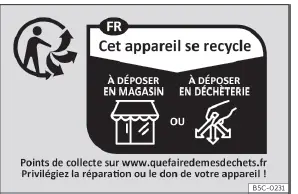
Fig. 230 Recycling notice for France.
For vehicles and accessories supplied in the French market, observe the sorting and recycling instructions illustrated in ››› Fig. 230. These instructions apply to the following items when they are discarded or have reached the end of their useful life. The relevant symbols indicate the appropriate disposal and collection arrangements under the French recycling system:
- Vehicle keys: Follow the applicable recycling instructions when disposing of a vehicle key or its associated electronic components.
- Remote control for auxiliary heating and ventilation: Dispose of the remote control through the appropriate collection channel, taking account of its electrical and electronic components.
- Compressor: Observe the specified recycling information when the compressor is no longer suitable for use.
- Charging cable: Follow the applicable sorting and collection instructions for the cable and its associated components.
- Mobile key card: Use the appropriate disposal procedure for the card in accordance with the recycling information provided for the French market.
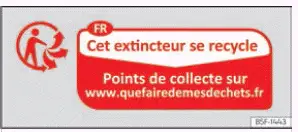
Fig. 231 Fire extinguisher recycling notice for France.
The recycling instructions shown in ››› Fig. 231 apply specifically to the following equipment. When the item is no longer required or has reached the end of its service life, follow the indicated collection and disposal procedure rather than treating it as ordinary household waste:
- Fire extinguishers: Observe the recycling and disposal instructions applicable to vehicle fire extinguishers in France, including the requirements associated with their safe handling at the end of their service life.
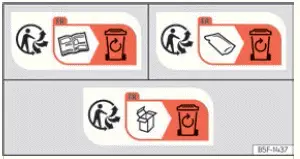
Fig. 232 Recycling notice for France.
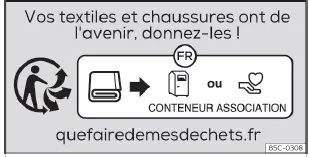
Fig. 233 Recycling notice for France.
The recycling information illustrated in ››› Fig. 232 and ››› Fig. 233 must be observed when disposing of the documentation, packaging or storage bags associated with the following items. These instructions concern the appropriate sorting and collection of the accompanying materials, which may require different disposal arrangements from the equipment itself:
- Maintenance manual: Sort and dispose of the manual or its associated packaging according to the recycling instructions shown.
- First aid kit: Follow the applicable sorting information for the packaging and storage materials supplied with the kit.
- Fire extinguishers: Observe the recycling instructions for the extinguisher's documentation, packaging or storage materials, as distinct from the disposal requirements for the extinguisher itself.
- Compressor: Sort the packaging, accompanying documents and any supplied storage bag in accordance with the relevant recycling symbols.
- Charging cable: Follow the indicated disposal instructions for the cable's packaging and associated storage materials.
- Charging socket and watertight seal: Observe the appropriate recycling guidance for the packaging and accompanying materials supplied with these components.
- Vehicle toolbox: Dispose of packaging and storage materials associated with the toolbox through the collection channels indicated by the recycling information.
- Puncture repair spray: Follow the applicable sorting instructions for the product's packaging and accompanying materials, while observing any separate disposal requirements for the product itself.
- Jack: Recycle the packaging, documents or storage materials supplied with the jack according to the indicated French sorting instructions.
- Warning triangle: Observe the recycling information for the warning triangle's packaging and protective storage materials.
- High visibility jacket: Sort the jacket's packaging and any accompanying storage bag according to the applicable recycling guidance.
- Tool bag: Follow the indicated collection and recycling instructions for packaging or other associated materials supplied with the tool bag.
For the sake of the environment
The Triman logo and Info-tri symbol provide important sorting and recycling information for consumers in France. These markings help identify products and packaging that are subject to separate collection requirements and indicate how the relevant materials should be sorted after use. Following the instructions associated with these symbols supports the correct collection, treatment and recycling of waste.
Product recycling
✓ Valid for market: Italy
Environmental labelling
Italian Legislative Decree No. 116 of 3 September 2020, which implements EU Directive 2018/851 concerning waste and EU Directive 2018/852 concerning packaging and packaging waste, establishes environmental labelling requirements for packaging. Under these provisions, packaging must carry appropriate information to support its identification, separate collection, reuse, recovery and recycling. The labelling requirements are also intended to provide consumers with clear guidance on the correct destination of packaging materials once they are no longer needed.
For packaging associated with the Seat Ateca and its equipment in the Italian market, the relevant environmental labelling information can be accessed by scanning the QR code shown below. The code directs users to a website containing the information required under the applicable legislation, including guidance concerning the identification and appropriate disposal of packaging materials. Consult this information when sorting or discarding packaging supplied with the vehicle or its accessories.

 Fluids in the air conditioning system
Refrigerant in the air conditioning system
The air conditioning system of the Seat Ateca uses a specific type and quantity of refrigerant to provide the required cooling performance. Information id ...
 Third-party copyright information
https://www.seat.com/company/softwareinfo.html
Certain electronic systems and products installed in the Seat Ateca contain software components distributed under Open Source licences. These licences ...
Other materials:
ACC system limitations
Adaptive Cruise Control (ACC) has technical and operational limitations that must be considered whenever the system is used. Although ACC can assist the driver by regulating speed and maintaining a selected distance from vehicles ahead, it cannot reliably identify every traffic situation or respond ...
Disassembly
Engine
Special Tool(s)
Material
WARNING: Do not smoke, carry lighted tobacco or have an open flame of any
type when working on or near any fuel-related component. Highly flammable
mixtures are always present and may be ignited. Failure to follow these
instructions may result in serious person ...
Privacy mode
Introduction
The "Privacy" function in the Seat Ateca allows users to control the exchange of information between the vehicle and the Internet. Depending on the selected privacy level, data transmissions can be permitted or restricted, affecting the availability of SEAT CONNECT services and other ...
