
Changing gears
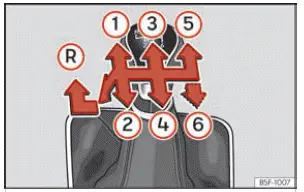
Fig. 97 Gear shift pattern of a 5 or 6-speed
manual gearbox.
The gear lever in a Seat Ateca equipped with a manual transmission has a shift pattern indicating the positions of the available forward gears and reverse gear, as illustrated in Fig. 97. The arrangement depends on whether the vehicle has a five-speed or six-speed manual gearbox. Familiarise yourself with the gear positions before driving, particularly when using a vehicle with a gearbox configuration that differs from one you are accustomed to. Correct gear selection and careful clutch operation help ensure smooth changes and reduce unnecessary wear on the transmission components.
- Fully depress the clutch pedal and keep it pressed all the way down while selecting a gear. This disengages the clutch and allows the gear change to be carried out without the engine continuing to transmit driving force through the transmission. Avoid attempting to move the gear lever before the clutch has been completely depressed.
- Move the gear lever into the desired gear position, following the shift pattern shown on the lever. Guide the lever smoothly and deliberately into the selected position rather than forcing it. Make sure the gear has been selected correctly before beginning to release the clutch.
- Release the clutch pedal smoothly after selecting the gear. Coordinate clutch release with the accelerator as necessary to maintain an even transition between gears and avoid unnecessary jerking. Once the gear change is complete, remove your foot from the clutch pedal.
Engaging reverse gear
Reverse gear must only be selected when the Seat Ateca has come to a complete stop. Attempting to engage reverse while the vehicle is still moving can place excessive stress on the gearbox and may cause mechanical damage. Before selecting reverse, make sure the vehicle is stationary and that the surrounding area is clear of obstacles and other road users.
- Fully depress the clutch pedal and hold it against the floor throughout the gear selection process. This disengages the clutch before the reverse gear mechanism is operated.
- With the gear lever in the neutral position, press the lever down, move it fully to the left and then push it forwards to engage reverse gear, as indicated by position R in Fig. 97. Follow this movement carefully to ensure that reverse is selected rather than an adjacent forward gear.
- Release the clutch pedal gradually and carefully when you are ready to move backwards. Control the vehicle's movement at a suitable low speed, paying attention to the available space and any obstacles behind the vehicle.
Changing to lower gears
When reducing speed or selecting a lower gear while driving, change down progressively through the gearbox whenever possible. Normally, this means selecting the gear immediately below the one currently engaged, provided the engine speed will remain within an appropriate operating range. Smooth, progressive downshifting helps maintain vehicle stability and avoids sudden changes in engine speed or excessive loading of the clutch and transmission.
Skipping one or more gears during a downshift at high road speeds or high engine revolutions can cause the engine and transmission components to be subjected to excessive rotational speeds. Selecting a gear that is too low for the vehicle's current speed may produce a substantial mismatch between the engine speed and the speed required by the transmission. This can damage the clutch or gearbox, even if the clutch pedal is fully depressed during the selection process. Always consider the vehicle's speed and the engine's operating range before changing to a lower gear, and avoid forcing the gear lever into an unsuitable position.
WARNING When the engine is running and a gear is engaged, the vehicle can begin moving as soon as the clutch pedal is released. This can happen even when the electronic parking brake is activated. An unexpected movement may result in a collision or cause serious injuries, particularly if people or obstacles are close to the vehicle. Always ensure that the vehicle is under control before releasing the clutch, and check that the intended direction of travel is clear.
- Never engage reverse gear while the vehicle is moving. Selecting reverse before the vehicle has stopped can damage the transmission and may cause an unexpected reaction that compromises vehicle control. Bring the Seat Ateca to a complete standstill before attempting to select reverse.
WARNING Incorrect downshifting can cause the driver to lose control of the vehicle. If a gear that is too low is selected while travelling at a high speed, the resulting sudden change in engine and transmission speeds can produce a strong braking effect or an abrupt change in the vehicle's behaviour. This may affect stability, particularly on slippery roads or while cornering, and can lead to an accident involving serious injuries. Always select a gear appropriate for the current road speed and driving conditions.
NOTICE Selecting an excessively low gear while travelling at high speed or while the engine is operating at high revolutions can cause serious damage to the clutch and gearbox. The difference between the transmission speed and the speed required by the selected gear may place excessive stress on internal components. Damage can occur even when the clutch pedal remains fully depressed and the gear has not yet been engaged through clutch release. Avoid selecting gears that are incompatible with the vehicle's current speed, and never force a gear change when the transmission does not engage smoothly.
NOTICE To protect the manual gearbox and clutch from unnecessary damage and premature wear, observe the following recommendations during everyday driving. Correct use of the gear lever and clutch pedal is important not only when changing gears but also when travelling at a steady speed or waiting in traffic.
- Do not leave your hand resting on the gear lever while driving. Even light, continuous pressure on the lever can be transmitted to the selector forks inside the gearbox. Over time, this unnecessary loading may contribute to premature wear of the gear selection mechanism. Once the required gear has been selected, remove your hand from the lever.
- Do not rest your foot on the clutch pedal when you are not changing gears. Even a small amount of pressure may partially operate the clutch mechanism and contribute to premature wear of the clutch disc. The clutch pedal should be used only when required for gear changes or other normal clutch operations.
When you are not operating the clutch, place your left foot on the designated footrest. This keeps unnecessary pressure off the clutch pedal and helps maintain a comfortable, stable driving position.
- Always make sure the vehicle has stopped completely before engaging reverse gear. Do not attempt to select reverse while the vehicle is still rolling forwards, even at a very low speed. Waiting until the vehicle is stationary helps protect the gearbox from unnecessary mechanical stress.
- Fully depress the clutch pedal every time you change gear. Incomplete clutch disengagement can make gear selection difficult and increase wear on the transmission components. Keep the pedal fully depressed until the desired gear has been selected, then release it smoothly.
- Do not hold the vehicle stationary on an uphill slope by allowing the clutch to slip while the engine is running. This practice, commonly called riding the clutch, generates excessive friction and heat and can damage the clutch disc. Use the brake to keep the vehicle stationary until you are ready to move off.
 Manually connecting and disconnecting
the Start-Stop system
Fig. 96 Centre console: Start-Stop system
button.
The Start-Stop system is designed to reduce fuel consumption and exhaust emissions by automatically switching off the engine when the vehic ...

Other materials:
General information
See the following sections for directions on how to properly use safety
restraints for children.
WARNING: Always make sure your child is secured properly in a
device that is appropriate for their height, age and weight. Child
safety restraints must be bought separately from your vehicle. Failure ...
Vehicle key
Fig. 43 Vehicle key
Fig. 44 Vehicle key with alarm button.
Unlocks the vehicle. Press this button to release the central locking system and allow access to the Seat Ateca. The unlocking function is operated remotely, provided the key is within its effective operating range.
Locks th ...
Exceptions
There are several exceptions to the Normal Schedule. They are listed
below:
Normal vehicle axle maintenance: Rear axles and power take-off
(PTO) units with synthetic fluid and light-duty trucks equipped with
Ford-design axles are lubricated for life; do not check or change fluid
unless a leak i ...
