
Towing a vehicle requires experience, careful coordination and a clear understanding of how both vehicles will behave during the manoeuvre. This is particularly important when a flexible tow cable is used, as maintaining a safe distance and consistent tension demands greater attention from both drivers. Before towing begins, the drivers should familiarise themselves with the specific procedures, limitations and safety precautions involved.
Drivers who have little or no experience with towing should not attempt the procedure. Incorrect handling can create dangerous situations, particularly when braking, turning or negotiating uneven road surfaces.
Throughout the towing operation, avoid excessive pulling forces, sudden jerks and abrupt changes in cable tension. The towing attachments are designed to withstand forces associated with proper towing, but unnecessary shock loads may damage them. Particular care is required on unpaved roads or surfaces that provide limited traction, where additional resistance can place excessive strain on the towing points and their mounting components.
Always observe the applicable traffic regulations and legal requirements concerning tow-starting and towing. These may include restrictions on towing speed, permitted equipment, warning signals and the circumstances in which a disabled vehicle may be moved on public roads.
Tow start
Tow-starting is a method of starting a vehicle's engine by having another vehicle pull it forward, allowing the movement of the wheels to turn the engine through the transmission. This procedure differs from conventional towing because its purpose is to start the engine rather than transport a disabled vehicle to another location.
Where tow-starting is technically permitted, a suitable tow bar or tow cable may be used to move the vehicle. However, the procedure is subject to specific restrictions depending on the transmission and engine type. These limitations must be checked before attempting to tow-start a Seat Ateca.
Towing
Towing involves using one vehicle to pull another vehicle that cannot continue driving under its own power. It may be necessary following a mechanical failure or another situation that prevents the disabled vehicle from being driven normally.
When the vehicle's condition permits conventional towing, a suitable tow bar or tow cable can be used. The following limits apply to towing the Seat Ateca under the conditions described in this manual:
- The maximum permitted towing speed is 50 km/h (30 mph). This limit must not be exceeded, even when road conditions would otherwise allow a higher speed.
- The maximum permitted towing distance is 50 km (30 miles). If the vehicle must be transported farther, an appropriate recovery vehicle should be used instead.
Tow cable and tow bar
A rigid tow bar is generally the safer and more suitable option for towing because it maintains a more consistent distance between the vehicles and reduces the likelihood of sudden pulling forces. Using a tow bar also helps minimise the risk of damage caused by abrupt changes in tension. A flexible tow cable should only be used when a suitable tow bar is unavailable.
If a tow cable is necessary, choose one with a degree of elasticity to absorb sudden changes in tension and reduce shock loads transmitted between the vehicles. A towing rope manufactured from synthetic fibres or another material with comparable elastic properties is recommended. The cable must also be suitable for the vehicles involved and securely attached to the designated towing points.
Towing with a tow truck
When professional roadside recovery equipment is used, vehicles equipped with an automatic transmission must only be towed with their front wheels raised clear of the road, as illustrated for the applicable front-wheel-drive configuration. This prevents the front wheels from rotating on the road during recovery and helps avoid potential damage to the transmission.
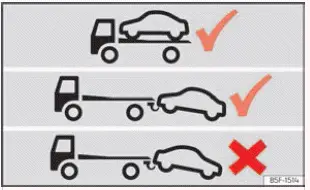
Fig. 195 Transport with a tow truck: vehicles with
an automatic gearbox and front wheel drive.
WARNING The handling characteristics and braking performance of a vehicle change significantly when it is being towed. The driver of the towed Seat Ateca must anticipate these differences and maintain sufficient distance from the towing vehicle. Steering and braking may require considerably greater effort than during normal driving, particularly when the engine is not running.
WARNING Never permit the vehicle to be towed if its electrical power supply is unavailable. Without sufficient electrical power, essential systems may not function correctly, creating a serious risk of losing control of the vehicle.
- While the vehicle is being towed, never remove the ignition key or switch off the ignition using the ignition and start button. Doing so may cause the electronic steering column lock to engage unexpectedly, preventing the driver from steering the vehicle. This could result in a collision, serious injuries or complete loss of vehicle control.
- If the vehicle loses electrical power during towing, stop the towing operation immediately in a safe location. Do not attempt to continue until the problem has been assessed. Contact qualified recovery personnel for assistance and arrange suitable transportation if necessary.
NOTICE Towing the Seat Ateca using a tow cable or rigid tow bar may cause damage to vehicle components, particularly if the towing procedure is performed incorrectly or the vehicle is unsuitable for conventional towing.
- If towing with a cable or tow bar cannot be avoided, proceed with particular care. Avoid sudden acceleration, harsh braking and abrupt pulling forces that could overload the towing attachments or other vehicle components.
- Whenever practical, arrange for the vehicle to be transported by a suitable tow truck. Professional recovery equipment is generally preferable when there is uncertainty about the condition of the vehicle or the suitability of conventional towing.
NOTICE Pushing the vehicle by hand can damage exterior body components if pressure is applied to unsuitable areas. The rear light assemblies, side spoilers surrounding the rear window and large sheet-metal body panels are particularly vulnerable to deformation or other damage.
Applying force to the rear spoiler may also loosen its mounting points or cause it to detach from the vehicle. These exterior components must not be used as pushing surfaces, even when the Seat Ateca only needs to be moved a short distance.
- If the vehicle must be pushed manually, avoid applying pressure to the rear light units, rear-window side spoilers, large body panels or rear spoiler. Use only appropriate, structurally suitable areas and take care not to damage the vehicle's exterior finish or attached components.
NOTICE Removing or refitting the towing-eye cover and installing the towing eye can damage surrounding bodywork if these operations are carried out carelessly. Scratches, chipped paint or damage to the cover and its mounting points may occur.
- Handle the towing-eye cover and towing eye carefully during removal and installation. Avoid using excessive force, and take precautions to prevent tools or metal components from contacting painted surfaces unnecessarily.
NOTICE Using a towing eye that is not designed for the vehicle may damage the towing attachment, its mounting point or surrounding body components. An incorrectly fitting towing eye may also fail to provide a secure connection during towing.
- Always use the towing eye supplied with the Seat Ateca as part of its on-board tool kit, or another towing eye specifically suitable for the vehicle. Check that the towing eye is correctly installed before attaching a tow bar or cable.

 Instructions for tow-starting and
towing
When the Seat Ateca is being towed with its hazard warning lights activated, the driver can still indicate an intended change of direction using the turn signals. With the ignition switched on, operat ...
Other materials:
Roadside Emergencies
Vehicles Sold in the United States: Getting Roadside Assistance
To fully assist you should you have a vehicle concern, Ford Motor
Company offers a complimentary Roadside Assistance program.
This program is separate from the New Vehicle Limited Warranty.
• 24 hours a day, seven days a week
...
Description and operation
The Start-Stop system is designed to reduce unnecessary fuel consumption and carbon dioxide (CO2) emissions by limiting the time the engine spends idling. It is particularly useful in traffic situations involving frequent stops, such as waiting at traffic lights or moving through congested roads. By ...
Interior luggage compartment release
WARNING: Keep vehicle doors and luggage compartment locked
and keep keys and remote transmitters out of a child’s reach.
Unsupervised children could lock themselves in the trunk and risk
injury. Children should be taught not to play in vehicles.
WARNING: Do not leave children, unreliable adu ...
