
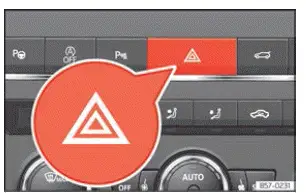
Fig. 41 Dashboard: hazard warning lights
button.
The hazard warning lights are intended to alert other road users to a vehicle that presents a potential hazard or is involved in an emergency. When activated, they cause the direction indicators to flash simultaneously, making the Seat Ateca more noticeable to approaching traffic. They are particularly important if the vehicle has broken down, must stop unexpectedly or is stationary in a location where other drivers need additional warning.
If your vehicle is stationary because of a breakdown or another emergency, take the following precautions to protect yourself, your passengers and other road users. Always assess the surrounding traffic conditions before leaving the vehicle or carrying out any action outside it.
1. Stop and park the vehicle in a safe location, keeping as much distance as possible between the Seat Ateca and moving traffic. Choose a position where the vehicle is clearly visible and does not create an unnecessary obstruction. Avoid stopping in a dangerous location if the vehicle can be moved safely to a more suitable place.
2. Press the hazard warning light button on the dashboard to activate the simultaneous flashing indicators. This warns approaching drivers that the vehicle is stationary or that an emergency situation has occurred.
3. Apply the electronic parking brake to secure the vehicle against unintended movement. Check that the parking brake has been engaged before proceeding with the remaining steps.
4. Switch off the engine once the vehicle has been brought to a safe stop. Do not leave the engine running unnecessarily while the vehicle is stationary during an emergency.
5. In vehicles equipped with a manual gearbox, engage first gear. If the Seat Ateca has an automatic transmission, move the selector lever to position P. These measures supplement the parking brake and help keep the vehicle stationary.
6. Comply with the emergency warning and roadside safety requirements applicable in the country where you are driving. Depending on local legislation, this may include wearing a reflective safety vest and using warning triangles, an approved warning beacon or other prescribed equipment. Position any required warning devices safely and in accordance with the relevant regulations.
7. Always take the vehicle key with you when leaving the Seat Ateca. Keep the key in your possession while attending to the emergency, and make sure that all occupants are moved to a safe location when it is appropriate to leave the vehicle.
When the hazard warning lights are activated, all direction indicators flash simultaneously. The two turn signal indicator lamps  in the instrument cluster and the indicator lamp in the hazard warning light switch
 flash at the same time. The hazard warning lights can also operate when the ignition is switched off, allowing the vehicle to remain visibly marked as a hazard while it is parked during an emergency.
While the hazard warning lights are operating, the direction indicator lever can still be used to signal a turn or lane change, for example when the vehicle is being towed. When a direction is selected, the hazard warning light function is temporarily interrupted so that the corresponding direction indicator can operate. Once the directional signal is cancelled, the hazard warning lights can resume their normal simultaneous flashing operation.
Emergency braking warning
If the Seat Ateca brakes sharply and continuously while travelling at a speed above 80 km/h (50 mph), the brake lights flash several times per second to warn drivers travelling behind that the vehicle is decelerating rapidly. This conspicuous flashing is intended to draw attention to the emergency braking situation and give following traffic an additional warning. If braking continues until the vehicle comes to a complete stop, the hazard warning lights activate automatically. They then switch off automatically when the vehicle begins moving again.
WARNING
- A vehicle breakdown increases the risk of an accident, especially when the vehicle is stationary near moving traffic. Always activate the hazard warning lights and use a warning triangle or approved warning beacon, as required by the regulations of the country concerned, to alert approaching road users. Take particular care when stopping on busy roads or in locations with restricted visibility, and do not expose yourself or other occupants to unnecessary danger while placing warning equipment.
- Never leave anyone unattended inside the vehicle, particularly children or people who may require assistance. This precaution is especially important if the doors are locked, because occupants may be unable to leave the vehicle without help. Temperatures inside a stationary vehicle can become dangerously high or low, creating a serious risk to anyone left inside. Make sure all occupants are safe and appropriately supervised during an emergency stop.
- The catalytic converter can reach extremely high temperatures during vehicle operation. Never park the Seat Ateca where the catalytic converter or other hot exhaust components could come into contact with highly flammable materials, such as dry grass or spilled petrol. Even after the engine has been switched off, these components may remain hot enough to ignite combustible substances.
Contact between hot exhaust components and flammable materials can cause a fire, potentially endangering the vehicle and its occupants. Always choose a safe parking surface and avoid stopping over vegetation, fuel spills or other materials that could ignite.
Note
- Leaving the hazard warning lights switched on for an extended period consumes electrical energy and can discharge the vehicle's 12-volt battery, even when the ignition is switched off. If the vehicle must remain stationary for a long time, bear in mind that prolonged operation of the warning lights may reduce the battery's available charge.
- The use of hazard warning lights and other emergency warning equipment is governed by the applicable legal requirements of each country. Always follow local regulations concerning when the hazard warning lights must be activated and which additional warning devices are required when a vehicle is stopped because of a breakdown or emergency.

 Behaviour in the event of an accident
or fire
Actions to take in the event of a fire or accident
In the event of a road accident or vehicle fire, protecting yourself and the other occupants must take priority. To reduce the risk of further accid ...
Other materials:
Limitations of the predictive speed
adjustment
Predictive speed adjustment is subject to the operating restrictions of both the road sign recognition system and Adaptive Cruise Control (ACC). In addition to these existing limitations, the predictive function has its own restrictions concerning the interpretation of road signs, navigation informa ...
Transmission
Automatic transmission
WARNING: Always set the parking brake fully and make sure
the gearshift is latched in P (Park). Turn the ignition to the off
position and remove the key whenever you leave your vehicle.
Your vehicle has been designed to improve fuel economy by reducing
fuel usage while co ...
Heated windows and mirrors (if equipped)
Heated Rear Window
Note: The ignition must be switched on to use this feature.
Press the button to clear the rear window of thin ice and fog. Press the
button again within 10 minutes to switch it off. It switches off
automatically after 10 minutes, or when you switch the ignition off.
Do no ...
