
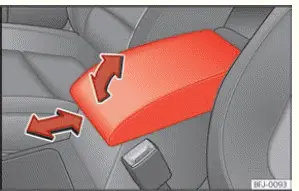
Fig. 77 Front centre armrest
The front centre armrest in the Seat Ateca can be adjusted vertically and horizontally to provide a comfortable resting position for the driver's or front passenger's arm. Its position can be changed according to the occupant's preference, provided that the adjustment does not interfere with the driver's ability to steer or operate the vehicle controls.
To raise the armrest, pull it upwards in the direction indicated by the arrow in Fig. 77. Depending on the height required, the armrest can be raised fully or adjusted progressively through its available positions. Select the height that provides suitable support without restricting normal arm movement.
To lower the armrest, first raise it completely to its highest position. Once it has reached the upper limit of its adjustment range, move it downwards to the required lowered position. This procedure allows the armrest to be returned from a raised setting without forcing the adjustment mechanism.
To adjust the armrest horizontally, slide it forwards or backwards in the directions indicated by the corresponding arrows in Fig. 77. The armrest can be moved through its available longitudinal adjustment range, allowing the supporting surface to be positioned closer to or farther from the occupants as required.
WARNING An incorrectly positioned front centre armrest can restrict the driver's arm movements and interfere with safe vehicle operation. If the armrest obstructs steering or prevents the driver from moving freely, it may contribute to an accident and cause serious injuries. Always adjust it so that the steering wheel and other driving controls can be operated without restriction.
- Keep the storage compartments incorporated into the centre armrest closed whenever the vehicle is moving. An open compartment may interfere with the occupants' movements or allow stored objects to become displaced during braking or sudden manoeuvres.
- Never allow anyone to sit on the front centre armrest while the vehicle is moving, including a child. The armrest is not a passenger seat and does not provide the seating position or restraint protection required for safe travel. Sitting on it can result in serious injuries during sudden braking, a collision or an abrupt change of direction.
Unlock the seat backrest with the cord.
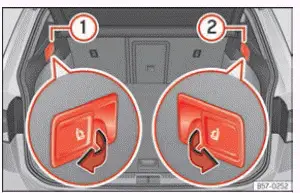
Fig. 78 In the luggage compartment: levers to
unlock the rear backrest.
The rear seat backrest sections can also be released from the luggage compartment using the corresponding remote release levers. This allows the rear backrests to be folded forwards without having to operate the release controls directly from the passenger compartment, making it easier to enlarge the available luggage space when loading the Seat Ateca.
- Lower the corresponding rear head restraint fully before releasing the backrest. This provides additional clearance and helps prevent the head restraint from coming into contact with the front seats as the backrest folds forwards.
- Open the rear lid to gain access to the remote backrest release levers located in the luggage compartment. Make sure that the backrest has sufficient room to move forwards and that no objects are obstructing its folding path.
- Pull the remote release lever for the left-hand backrest section, marked 1 in Fig. 78, or the right-hand section, marked 2, in the direction indicated by the arrow. The corresponding rear seat backrest is released from its locking mechanism and folds forwards and downwards automatically. Make sure that no person or object is within the movement area of the backrest.
- Once the required backrest section has folded forwards, close the rear lid if appropriate. Before loading the luggage compartment, check that the folded backrest is in the intended position and that the load can be accommodated without damaging the interior.
The rear seat backrest is not securely engaged in its upright locking position whenever the red marking on button 2 in Fig. 71 remains visible. After returning a folded backrest to its normal seating position, always check that this red marking has disappeared and that the backrest is firmly locked before allowing anyone to occupy the corresponding rear seat.
 Memory function
Fig. 76 On the outer side of the driver's seat:
memory buttons.
Memory buttons
The memory buttons on the outer side of the driver's seat allow preferred settings for the driver's seat and ...
 Lights
...
Other materials:
Introduction
The emergency brake assistance system, known as Front Assist, is designed to help prevent frontal collisions with certain objects and road users in the vehicle's path. When a collision cannot be avoided, the system aims to reduce the severity of the impact by warning the driver and, under suitable c ...
Lane Departure Warning
DESCRIPTION AND OPERATION
Lane Departure Warning
Overview
The LDW is composed of the lane keeping alert and lane keeping aid functions.
The lane keeping alert detects unintentional drifting toward the outside of the
lane and alerts the driver to stay in the lane through the EPAS&nbs ...
Troubleshooting
Steering fault
The steering warning lamp illuminates red on the instrument cluster. A red indication identifies a serious steering system malfunction that requires immediate attention and must not be treated as a routine notification.
A fault has been detected in the electromechanical powe ...
