
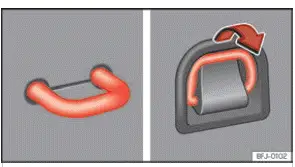
Fig. 174 In the luggage compartment:
fastening rings.
The Seat Ateca luggage compartment is equipped with fastening rings positioned at the front and rear of the load area, as shown in Fig. 174. These attachment points are intended for securing luggage and other transported objects using suitable retaining straps, belts or cords. Correctly securing the load helps prevent items from sliding or shifting during acceleration, braking and cornering. The fastening rings should be used with securing equipment appropriate for the weight and shape of the cargo being transported.
WARNING Using unsuitable, worn or damaged retaining belts and straps can result in the securing equipment breaking during sudden braking or a collision. If the restraints fail, luggage and other objects may be thrown through the vehicle interior with considerable force, potentially causing serious or fatal injuries. The load must therefore be secured with appropriate equipment that is in good condition and correctly attached to the designated fastening rings.
- Always use retaining belts or straps that are suitable for the load being transported and are free from damage. Check their condition before use, paying particular attention to signs of wear, cuts, fraying or damaged fastening components. Do not use equipment that may fail when subjected to sudden forces.
- Arrange the securing belts or straps in a crossed pattern over the cargo positioned on the luggage compartment floor. Attach them securely to the designated fastening rings and tighten them sufficiently to prevent the load from moving. Make sure the straps remain correctly positioned and do not slip off the objects they are intended to restrain.
- Never exceed the maximum permitted tensile load of the fastening rings when securing luggage or other objects. Excessive force can damage the attachment points or cause them to fail, particularly during emergency braking or an accident. Select a securing arrangement that remains within the specified load limits.
- When securing cargo, particularly flat objects, make sure that the upper edge of the load is positioned higher than the fastening rings. This allows the retaining straps to pass over the objects in the intended arrangement and helps provide effective restraint against movement.
- Depending on the equipment installed in the vehicle, observe any information labels or instruction panels provided in the luggage compartment. These may contain guidance on the correct positioning of luggage and the use of the available load-securing equipment. Follow the instructions applicable to the particular vehicle configuration.
- Never attach or secure a child restraint system to the luggage compartment fastening rings. These rings are designed for securing cargo and must not be used as child seat anchorage points. Child seats must be installed using the designated restraint attachment systems provided for that purpose.
Note
- The fastening rings have a maximum tensile load capacity of approximately 3.5 kN. This value represents the specified limit for the force applied to the attachment points. When securing cargo, make sure that the chosen straps and fastening arrangement do not subject the rings to forces exceeding this capacity.
- Suitable cargo-securing belts, straps and other retaining systems are available from specialist automotive accessory suppliers. SEAT recommends contacting an authorised SEAT dealership for advice on appropriate load-securing equipment and accessories compatible with the vehicle.
Note In Seat Ateca versions equipped with a spare wheel, the luggage compartment fastening rings are not usable. The availability and practical use of these attachment points therefore depend on the vehicle's equipment configuration. Take this limitation into account when planning how luggage and other cargo will be secured.

 Net bag
Fig. 175 In the boot: net bag hooked up at floor
level.
Fig. 176 In the luggage compartment: rings 1
and hooks 2 for attaching the net bag.
The luggage compartment net bag help ...
Other materials:
Rear Drive Axle/Differential
SPECIFICATIONS
Material
Torque Specifications
DESCRIPTION AND OPERATION
Rear Drive Axle and Differential
The rear drive axle consists of the following components:
Dished circular flange
Full-time Active Torque Coupling (ATC)
Aluminum housing with steel housing cover
Matched ring and pinion ...
Jump-starting the vehicle
WARNING: The gases around the battery can explode if exposed
to flames, sparks, or lit cigarettes. An explosion could result in
injury or vehicle damage.
WARNING: Batteries contain sulfuric acid which can burn skin,
eyes and clothing, if contacted.
Do not attempt to push-start your automatic tr ...
Seat heating
With the engine running, the electrically heated seats can provide additional warmth independently of the passenger compartment air temperature. Depending on the Seat Ateca's equipment, heating is available for the front seats and the outer rear seats. The heating intensity can be selected from thre ...
