
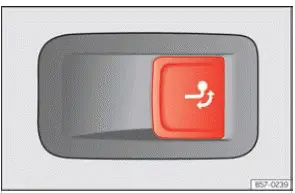
Fig. 182 Right side of the luggage
compartment: button to unlock the tow hitch.
The Seat Ateca electrically operated tow hook is integrated into the rear bumper area when it is not in use. Unlike a detachable towing ball, this tow hook remains permanently connected to the towing mechanism and cannot be removed from the vehicle. It can be electrically unlocked and then moved by hand between its extended towing position and its retracted storage position beneath the bumper.
Before operating the tow hook, make sure that its entire movement area is clear. No person, animal or object must be positioned in the path through which the hook swings when it is extended or retracted. The mechanism must be allowed to move freely without encountering an obstruction, and particular care should be taken when operating it near the rear of the vehicle.
Unlocking the tow hook and removing it
- Bring the Seat Ateca to a complete stop on a suitable surface and apply the electronic parking brake. Make sure the vehicle is securely stationary before operating the towing mechanism.
- Switch off the engine. The tow hook must be operated while the vehicle is parked, not while preparing to move or during driving.
- Open the rear lid to access the electric tow hook release button located on the right-hand side of the luggage compartment.
- Briefly pull the button shown in ››› Fig. 182. The towing mechanism unlocks electrically, allowing the tow hook to swing outwards automatically from its stored position. The indicator lamp in the button begins flashing to show that the hook has been released but has not yet reached its fully engaged position.
- Continue moving the tow hook outwards by hand until it reaches its operating position. You must be able to feel and hear the mechanism engage securely. Once the tow hook is correctly locked in place, the indicator lamp in the release button remains continuously illuminated. Do not attach a trailer until the hook has fully engaged.
- Close the rear lid after confirming that the tow hook is securely locked in its extended position. Make sure the luggage compartment is properly closed before preparing the vehicle for towing.
- Proceed with hitching and connecting the trailer. Attach the trailer coupling to the tow ball, secure the required safety connection and establish the electrical connection using the designated trailer socket. Follow the applicable instructions for hitching and connecting a trailer before setting off.
Retracting the tow hook
- Stop the Seat Ateca completely and apply the electronic parking brake. The vehicle must remain stationary throughout the procedure for returning the tow hook to its storage position.
- Switch off the engine before operating the electrically released towing mechanism.
- Unhitch the trailer and disconnect its electrical plug from the vehicle's trailer socket. If an adapter has been used between the trailer connector and the vehicle socket, remove the adapter as well. Make sure that no trailer, carrier or other accessory remains attached to the tow hook.
- Open the rear lid to reach the tow hook release control on the right-hand side of the luggage compartment.
- Briefly pull the button illustrated in ››› Fig. 182. The tow hook is electrically unlocked, allowing it to be moved from its extended position. Ensure that the area beneath and behind the bumper is clear before continuing.
- Using your hand, swing the tow hook back beneath the rear bumper until it reaches its fully retracted position. Continue until you feel and hear the locking mechanism engage. The indicator lamp in the release button must remain steadily illuminated, confirming that the tow hook has been correctly secured in its storage position.
- Close the rear lid once the tow hook has been fully retracted and its locked position has been confirmed. The towing mechanism should remain securely stowed beneath the bumper when it is not required.
The button's control lamp
 Flashing: A flashing indicator means that the tow hook has not yet locked correctly into its intended position or that the mechanism may be damaged. This indication can appear while the hook is being moved between its extended and retracted positions. If the lamp continues flashing after the hook has been moved fully into position, do not assume that the mechanism is secure. The towing bracket must not be used unless the hook is correctly engaged.
 Remains on: When the indicator lamp remains continuously illuminated while the rear lid is open, the tow hook has engaged correctly. This confirmation applies both when the hook is fully extended and ready for towing and when it is completely retracted beneath the bumper. A steady light indicates that the mechanism has reached and locked into one of its designated positions.
The indicator lamp in the tow hook release button switches off automatically approximately one minute after the rear lid has been closed. This is normal operation and does not mean that the hook has become unlocked. The locking condition should be confirmed while the rear lid is open and the indicator is available for inspection.
WARNING Incorrect operation or improper use of the electrically operated towing bracket can cause accidents and serious injuries. The tow hook moves through a defined area behind the vehicle and must lock securely before it can be used to support a trailer or compatible accessory. Attempting to use the mechanism while it is moving, incorrectly engaged or damaged can create a dangerous situation. Always follow the specified operating procedure and observe the following safety precautions.
- Only use the tow hook when it is fully extended and correctly engaged in its locked position. Confirm that the locking mechanism has engaged securely and that the release button's indicator lamp shows the appropriate status. Never attach a trailer or other permitted load to a hook that has not locked properly.
- Before extending or retracting the tow hook, always check that no person, animal or object is within its movement area. Keep hands and other parts of the body away from the mechanism while it is being released or moved. The hook must have sufficient unobstructed space to reach its intended position safely.
- Never use tools, levers or other instruments to force or assist the tow hook while it is moving. The mechanism is designed to be electrically unlocked and then positioned by hand. Applying force with an unsuitable tool could damage the locking components or cause unexpected movement, creating a risk of injury.
- Never operate the release button shown in ››› Fig. 182 while a trailer is coupled to the vehicle or while a bicycle carrier, load carrier or any other accessory is mounted on the tow hook. The towing mechanism must not be unlocked while it is supporting an attached load. Always disconnect and remove the trailer or accessory completely before operating the release control.
- If the tow hook does not engage correctly in its extended or retracted position, do not use the towing bracket. An incompletely locked hook may move unexpectedly or fail under load. Have the towing mechanism inspected by a specialised workshop and do not attempt to tow a trailer until the fault has been corrected.
- If you notice any malfunction in the electrical release system or the towing bracket itself, contact a specialised workshop and arrange for the equipment to be checked. Unusual operation, failure to unlock, incorrect indicator behaviour or difficulty engaging the hook may indicate a fault. Do not attempt to modify or repair the mechanism yourself.
- If the tow ball measures less than 49 mm in diameter at any point, the towing bracket must not be used under any circumstances. A ball that has worn below this minimum dimension may no longer provide a sufficiently secure connection with the trailer coupling. Stop using the equipment and have its condition assessed by a qualified specialist.
NOTICE When washing the Seat Ateca with a high-pressure cleaner or steam-cleaning equipment, never direct the cleaning jet at the retractable tow hook mechanism or the trailer electrical socket. High-pressure water or steam can penetrate the moving joints and electrical connections, potentially causing damage or removing the grease required for proper lubrication. Loss of lubrication may affect the smooth operation and durability of the towing mechanism. Clean the surrounding area carefully without exposing these components directly to a concentrated jet.
Note At extremely low temperatures, the electrically operated tow hook may become difficult or impossible to move. Cold conditions can interfere with the normal movement of the mechanism, particularly if moisture around its components has frozen. If the hook cannot be operated, move the Seat Ateca to a warmer location, such as a garage, and allow the mechanism to warm up before attempting to use it again. Do not force the tow hook if it remains stuck.
 Stabilisation of the towing vehicle
and trailer combination
The trailer stabilisation function is an additional feature of the electronic stability control (ESC) system in the Seat Ateca. It is designed to support the stability of the towing vehicle and traile ...
 Installing a rear carrier system or a
bicycle rack on the trailer hitch
Fig. 183 Recommended weight distribution on
the rear carrier system.
Rear carrier systems are accessories mounted on the vehicle's trailer hitch to transport items outside the luggage co ...
Other materials:
Driving with the speed warning function
Operating conditions
The speed warning function in the Seat Ateca operates at vehicle speeds above 20 km/h. When the function is active, it monitors the vehicle's speed in relation to the speed limit identified by the road sign recognition system and provides warnings when the applicable threshold ...
Introduction
The roof of the Seat Ateca has been designed with particular attention to aerodynamic efficiency. Its shape helps manage airflow over the vehicle and reduce unnecessary air resistance during driving. Because of this roof construction, conventional roof carrier systems and crossbars cannot be attache ...
911 Assistâ„¢
WARNING: Unless the 911 Assist setting is set on prior to a
crash, the system will not dial for help which could delay
response time, potentially increasing the risk of serious injury or death
after a crash.
WARNING: Do not wait for 911 Assist to make an emergency
call if you can do it yourself ...
