
SPECIFICATIONS
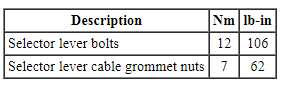
Torque Specifications
DESCRIPTION AND OPERATION
External Controls
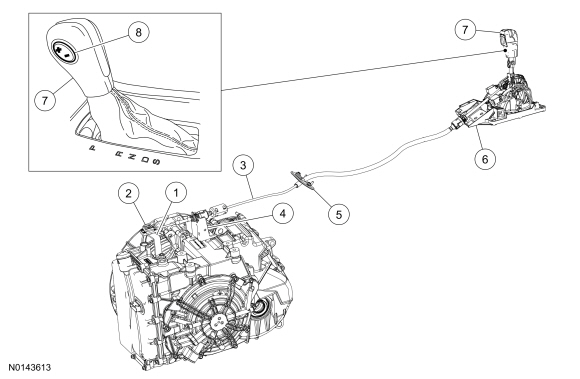
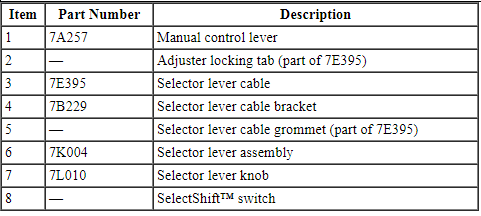
The transmission selector lever linkage consists of:
- a selector lever cable that connects the transmission manual control lever to the selector lever assembly.
- a BSIA that is integral to the selector lever assembly.
The selector lever assembly:
- locks the transmission selector lever in the PARK position when the ignition switch is in the LOCK position.
- requires the transmission selector lever to be in the PARK position to turn the ignition switch to the LOCK position.
Range Selection
This transmission has 5 range positions: P, R, N, D and S.
Selector Lever
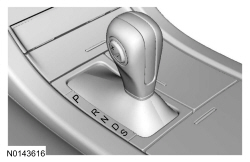
Park
In the PARK position:
- there is no powerflow through the transmission.
- the parking pawl locks the final drive.
- the engine may be started.
- the ignition key may be removed.
Reverse
In the REVERSE position:
- the vehicle may be operated in a rearward direction, at a reduced gear ratio.
- engine braking will occur.
Neutral
In the NEUTRAL position:
- there is no powerflow through the transmission.
- the output shaft is not held and is free to turn.
- the engine may be started.
Drive
DRIVE is the normal position for most forward driving.
In the DRIVE position:
- the transmission provides automatic shifts - 1st through 6th gears.
- the TCC is applied and released.
- temporary manual control is provided when pulling the paddles shifters. The system will determine when temporary manual control is no longer desired and reverts back to automatic control.
- the transmission provides maximum fuel economy during normal operation.
Sport
In the SPORT position:
- the transmission provides maximum engine braking.
- gears 1 through 6 are available.
- the driver can manually shift the transmission to gears 1 through 6 using the steering wheel mounted paddle shift, or the SelectShift switch on the selector lever.
- the transmission will select gears that will provide the engine braking desired, based on the vehicle inputs, this will increase engine rpm during engine braking.
SelectShift
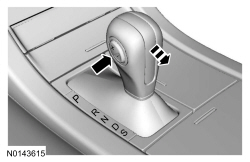
SelectShift Switch
When the selector lever is moved to the S position, the driver can shift the transmission manually using the SelectShift switch mounted on the selector lever knob.
Paddle Shifter (SHO only)
When the selector lever is moved to the S position, the driver can shift the transmission manually using the steering wheel mounted paddle shifters.
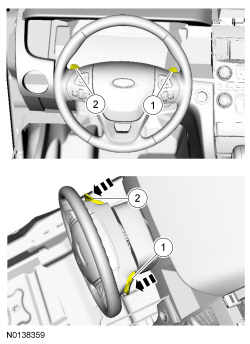
- Upshift
+ - Downshift
-
With SelectShift:
- the driver can manually shift the transmission to gears 1 through 6.
- the current gear illuminates on the IC.
- the transmission provides additional grade (engine) braking.
- the transmission will select gears that will provide the engine braking desired, based on the vehicle inputs, this will increase engine rpm during engine braking.
The transmission will make some shifts automatically primarily to protect the engine from stalling.
It is recommended to return to DRIVE mode on flat terrain to provide the best fuel economy and transmission function. The transmission returns to O/D when the selector lever is moved to the DRIVE position.
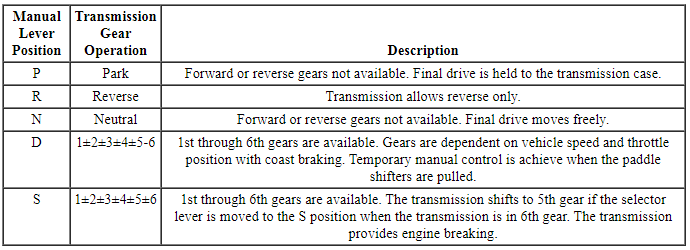
Gear Availability

 Diagnosis and Testing
External Controls
Inspection and Verification
Verify the customer concern by operating the system.
Visually inspect for obvious signs of mechanical or electrical damage.
If the concern is not ...
Other materials:
Fuel Charging and Controls - Turbocharger, 3.5L GTDI
SPECIFICATIONS
Material
Torque Specifications
a Refer to the procedure in this section.
DESCRIPTION AND OPERATION
Turbocharger
NOTICE: Whenever turbocharger air intake system components are
removed, always cover open ports to protect from debris. It is important that no
foreign materia ...
Running out of fuel
Avoid running out of fuel because this situation may have an adverse
effect on powertrain components.
If you have run out of fuel:
• You may need to cycle the ignition from off to on several times after
refueling to allow the fuel system to pump the fuel from the tank to
the engine. On rest ...
Transfer Case - Power Transfer Unit (PTU)
SPECIFICATIONS
Material
Torque Specifications
a Refer to the procedure in this section.
DESCRIPTION AND OPERATION
Power Transfer Unit (PTU)
The AWD system consists of the following:
PTU
Rear driveshaft
AWD module
Rear axle with coupling device
The PTU is a mecha ...
