
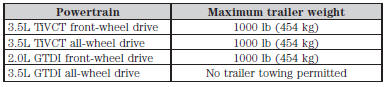
Note: Do not exceed the trailer weight for your vehicle configuration listed in the chart below.
Note: Make sure to take into consideration trailer frontal area. Do not exceed 12 feet2 (1.11 meters2) trailer frontal area.
Note: For high altitude operation, reduce the gross combined weight by 2% per 1000 feet (300 meters) starting at the 1000 foot (300 meter) elevation point.
Note: Certain states require electric trailer brakes for trailers over a specified weight. Be sure to check state regulations for this specified weight. The maximum trailer weights listed may be limited to this specified weight, as your vehicle’s electrical system may not include the wiring connector needed to use electric trailer brakes.
Your vehicle may tow a Class I trailer provided the maximum trailer weight is less than or equal to the maximum trailer weight listed for your vehicle configuration on the following chart.
 Trailer towing
WARNING: Do not exceed the GVWR or the GAWR specified on
the certification label.
WARNING: Towing trailers beyond the maximum recommended
gross trailer weight exceeds the limit of your vehicle and ...
 Essential towing checks
Follow these guidelines for safe towing:
• Do not tow a trailer until you drive your vehicle at least 1000 miles
(1600 kilometers).
• Consult your local motor vehicle laws for towing a traile ...
Other materials:
Cleaning products
For best results, use the following products or products of equivalent
quality:
Motorcraft Bug and Tar Remover (ZC-42)
Motorcraft Custom Bright Metal Cleaner (ZC-15)
Motorcraft Detail Wash (ZC-3-A)
Motorcraft Dusting Cloth (ZC-24)
Motorcraft Engine Shampoo and Degreaser (United States only) (Z ...
Exceptions
There are several exceptions to the Normal Schedule. They are listed
below:
Normal vehicle axle maintenance: Rear axles and power take-off
(PTO) units with synthetic fluid and light-duty trucks equipped with
Ford-design axles are lubricated for life; do not check or change fluid
unless a leak i ...
Gauges
Type 1
Cluster shown in standard measure – metric clusters similar.
A. Tachometer
B. Information display. See Information displays for more information.
C. Speedometer
D. Fuel gauge
Fuel gauge
Indicates approximately how much fuel is left in the fuel tank (when the
ignition is on). The f ...
