
Before carrying out any inspection, maintenance or repair work in the engine compartment of the Seat Ateca, the vehicle must be prepared correctly. Follow the steps below in the specified order to prevent unexpected movement, accidental engine starting and other potentially dangerous situations. Do not begin working until all the necessary safety precautions have been completed.
1. Park the vehicle on a firm, level surface where it can remain stationary throughout the maintenance procedure. Choose a safe location with sufficient room around the vehicle and make sure that the ground is stable enough to support it securely.
2. Depress the brake pedal firmly and keep it pressed until the ignition has been switched off. Maintaining pressure on the brake pedal during the shutdown procedure helps keep the vehicle stationary while the remaining preparations are completed.
3. Apply the electronic parking brake to secure the vehicle against unintended movement. Make sure that the parking brake has engaged correctly before continuing with the next step.
4. Manual transmission: move the gear lever into the neutral position. Confirm that no gear remains engaged before proceeding with the maintenance preparations.
Automatic transmission: move the selector lever to position P (Park). Ensure that the selector is correctly engaged in this position before switching off the ignition.
5. Switch off the ignition completely. Check that the engine has stopped and that the vehicle is no longer in an operating condition that could result in an unintended engine start.
6. Remove the vehicle key from the vehicle and keep it in a secure location outside the passenger compartment. This precaution reduces the possibility of someone accidentally activating the ignition or starting the engine while work is being performed in the engine compartment.
7. Allow the engine to cool sufficiently before opening the bonnet or touching components inside the engine compartment. The engine, exhaust system and cooling system may remain hot for a considerable period after the vehicle has been switched off. Do not begin work near hot components until the risk of burns has been adequately reduced.
8. Keep other people, particularly children and anyone not involved in the maintenance procedure, at a safe distance from the engine compartment. Make sure that nobody can operate the vehicle controls or interfere with the work while the bonnet is open.
9. Secure the vehicle against rolling or moving unexpectedly. Check that it is properly immobilised before beginning any maintenance operation, especially if the work requires reaching into the engine compartment or positioning yourself close to the vehicle.
WARNING For your personal safety, never overlook or disregard any of the preparation steps described above. Failing to secure the vehicle correctly or taking shortcuts during maintenance preparations can result in unexpected vehicle movement, accidental engine operation, serious accidents and potentially life-threatening injuries.
- Always complete the preparation checklist in the specified order and observe all general safety precautions applicable to work in the engine compartment. If any requirement cannot be fulfilled safely, do not proceed with the maintenance operation. Seek assistance from a qualified specialist workshop instead.
Opening and closing the bonnet
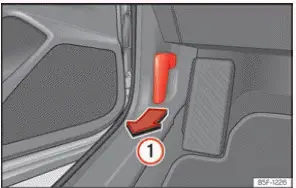
Fig. 206 Release lever in the driver's footwell
area.
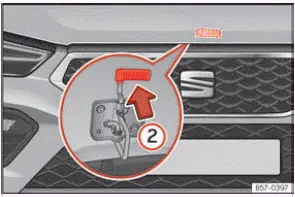
Fig. 207 Lever under the bonnet.
Opening the bonnet
The bonnet of the Seat Ateca is initially released using a lever inside the passenger compartment. A secondary safety catch beneath the front edge of the bonnet must then be disengaged before the bonnet can be raised fully. Follow the correct sequence to avoid damaging the release mechanism or surrounding bodywork.
Before opening the bonnet, check that both windscreen wiper arms are resting in their normal position against the windscreen. If either wiper arm has been lifted away from the glass, return it to its normal position before proceeding. Opening the bonnet with the wiper arms raised may cause the bonnet to strike them, potentially damaging the wipers, bonnet or windscreen.
- Open the driver's door and locate the bonnet release lever beneath the dashboard in the driver's footwell. Pull the lever indicated by position 1 in Fig. 206 to release the primary bonnet locking mechanism. The bonnet will be released from its fully closed position, allowing access to the secondary safety catch.
- Move to the front of the vehicle and locate the release catch underneath the front edge of the bonnet. Push the catch upwards, as indicated by position 2 in Fig. 207, to disengage the safety hook. Once the retaining hook has been released, the bonnet can be lifted.
- Raise the bonnet carefully to its open position. Release the bonnet support rod from its retaining clip and insert it securely into the designated mounting point on the bonnet. Make sure the support rod is correctly seated and that the bonnet is stable before reaching into the engine compartment or beginning any inspection.
Closing the bonnet
- Lift the bonnet slightly to relieve the pressure on the support rod. Keep the bonnet securely supported while preparing to return the rod to its storage position.
- Remove the bonnet support rod from its mounting point and carefully return it to its designated retaining support. Check that the rod is properly secured so that it cannot move freely or interfere with the bonnet when it is closed.
- Lower the bonnet carefully until it is approximately 20 cm above its closed position, then release it and allow it to drop under its own weight so that the locking mechanism engages correctly.
If the bonnet does not latch securely, do not attempt to force it closed by pressing down on its surface. Applying pressure in this way may damage the bonnet or its locking mechanism. Instead, lift the bonnet again and repeat the closing procedure, allowing it to fall from the specified height until the latch engages properly.
WARNING Always verify that the bonnet is fully closed and securely locked before driving the Seat Ateca. A bonnet that is not properly latched may open unexpectedly while the vehicle is moving, creating an extremely dangerous situation.
If the bonnet opens during a journey, it may obstruct the driver's forward view and cause loss of control, potentially resulting in a serious accident. Before setting off, check that the bonnet is correctly seated and that the locking mechanism has engaged securely. Never drive with a bonnet that cannot be closed and locked properly.
NOTICE In cold or snowy weather, ice and snow may accumulate in the gap between the bonnet and the windscreen, particularly around the bonnet hinges. If the bonnet appears frozen or does not open freely, do not force it upwards. First check the affected area and make sure that any accumulated ice or snow has been removed sufficiently to allow the bonnet to move without obstruction. Forcing the bonnet open while ice is present may damage the hinges, bodywork or adjacent components.
NOTICE To prevent damage to the bonnet and windscreen wiper arms, only open the bonnet when the wipers are resting against the windscreen in their normal parked position. Raised wiper arms may come into contact with the bonnet as it opens, causing damage to the wiper mechanisms, painted surfaces or glass. Always check their position before operating the bonnet release.
 Working in the engine compartment
The engine compartment of the Seat Ateca contains components and systems that can present serious hazards during inspection, maintenance or repair. Work in this area should only be undertaken by someo ...
 Fluids and consumables
Introduction
Vehicle operating fluids and consumable components, including engine coolant and vehicle batteries, are continually being developed and improved. Their specifications, formulations and s ...
Other materials:
Fuel quality
Note: Use of any fuel other than those recommended may cause
powertrain damage and a loss of vehicle performance; repairs may not be
covered under warranty.
Choosing the Right Fuel (Gasoline Engines)
Use only UNLEADED gasoline or UNLEADED gasoline blended with a
maximum of 15% ethanol in your g ...
Coolant specifications
The engine cooling system of the Seat Ateca is filled at the factory with a carefully formulated mixture of specially treated water and a minimum of 40% G12evo coolant additive, meeting specification TL-VW 774 L. This coolant mixture is designed to provide the necessary protection against freezing, ...
Troubleshooting
Emergency Assist not available
When Emergency Assist is unavailable, the corresponding warning lamp illuminates yellow in the instrument cluster. A message also appears on the display to inform the driver that the system cannot currently provide its emergency assistance functions. This condition ...
