
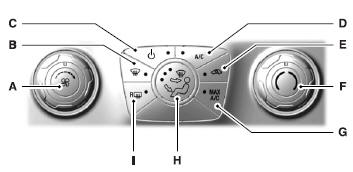
A. Fan speed control:
Controls the volume of air circulated in your vehicle. Turn to select the desired fan speed or switch off. If you switch the fan off, the windshield may fog up.
B. Defrost:
Distributes air through the windshield defroster vents and demister vents. This setting can also be used to defog and clear the windshield of a thin covering of ice.
C. Power:
Press to turn the system off and on. When the system is off, outside air cannot enter the vehicle.
D. A/C:
Press to turn air conditioning off and on. Air conditioning cools the vehicle using outside air. To improve air conditioning when starting your vehicle, drive with the windows slightly open for two to three minutes.
E. Recirculated air:
Press to switch between outside air and recirculated air. When the LED on the button is lit, the air currently in the passenger compartment is being recirculated. Using recirculated air can reduce the time needed to cool the interior and reduce unwanted odors from entering your vehicle.
F. Temperature control: Controls the temperature of the air circulated in your vehicle. Turn to select the desired temperature.
G. MAX A/C: Distributes recirculated air through the instrument panel vents to cool the vehicle. This position is more economical and efficient than normal air conditioning.
H. Air distribution control: Press to set the air distribution to a position listed below:
 Distributes air through the
windshield defroster vents, demister
vents and floor vents.
 Distributes air through the
instrument panel vents.
 Distributes air through the
instrument panel vents, floor vents,
and demister vents.
 Distributes air through the
floor vents.
I. Rear defrost: Turns the heated windows and mirrors off and on.
See Heated windows and mirrors later in this chapter for more information.
 Climate Control
...
 Dual automatic temperature control
Note: You can switch temperature units between Fahrenheit and Celsius.
See Menu features in the MyFord Touch or MyLincoln Touch chapter.
A. Power/Driver temperature control: Press to turn the ...
Other materials:
Reporting safety defects (U.S. only)
Your satisfaction is important to Ford Motor Company and to your dealer.
If a warranty concern has not been resolved using the three-step
procedure outlined earlier in this chapter in the Getting the Services
You Need section, you may be eligible to participate in the BBB AUTO
LINE program.
...
Front Drive Halfshafts
SPECIFICATIONS
Torque Specifications
a Refer to the procedure in this section.
DESCRIPTION AND OPERATION
Front Drive Halfshafts
The halfshafts consist of the following components:
Inner CV joints
Outer CV joints
Interconnecting shafts
The halfshafts are splined on the outboard stub ...
Universal Garage Door Opener (If Equipped)
HomeLink® wireless control system
WARNING: Make sure that the garage door and security device
are free from obstruction when you are programming. Do not
program the system with the vehicle in the garage.
WARNING: Do not use the system with any garage door opener
that does not have the safety s ...
