
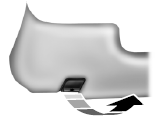
1. Inside the vehicle, pull the hood release handle located under the bottom of the instrument panel near the steering column.
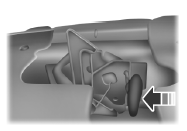
2. Go to the front of the vehicle and release the auxiliary latch that is located under the front center of the hood.
3. Lift the hood.
 General information
Have your vehicle serviced regularly to help maintain its roadworthiness
and resale value. There is a large network of Ford authorized dealers who
are there to help you with their professional servi ...
 Under hood overview
3.5L V6 engine
A. Engine coolant reservoir
B. Windshield washer fluid reservoir
C. Brake fluid reservoir
D. Battery
E. Power distribution box
F. Air filter assembly
G. Automatic transmission ...
Other materials:
General Procedures
Remote Keyless Entry (RKE) Transmitter Programming
NOTE: The Remote Keyless Entry (RKE) transmitter of the Integrated
Keyhead Transmitter (IKT) is programmed automatically during the Passive
Anti-Theft System (PATS) programming. For information on programming
the IKT keys, refer to ...
Transmission fluid check
6F35 TRANSMISSION (if equipped)
Note: Transmission fluid should be checked by an authorized dealer.
If required, fluid should be added by an authorized dealer.
The automatic transmission does not have a transmission fluid dipstick.
Refer to your scheduled maintenance information for schedu ...
Adjusting the steering wheel
WARNING: Do not adjust the steering wheel when your vehicle
is moving.
Note: Make sure that you are sitting in the correct position. See
Sitting
in the Correct Position in the Seats chapter.
1. Unlock the steering column.
2. Adjust the steering wheel to the
desired position.
3. Lock t ...
