
The system will automatically turn on your high beams if it is dark enough and no other traffic is present. When it detects an approaching vehicle’s headlights, a preceding vehicle’s tail lamps or street lighting, the system will turn off the high beams (low beams remain on) before they distract other drivers.
Note: If it appears that automatic control of the high beams is not functioning properly, check the windshield in front of the camera for blockage. A clear view of the road is required for proper system operation. Any windshield damage in the area of the camera field-of-view should be repaired.
Note: If a blockage is detected (e.g. bird dropping, bug splatter, snow, or ice) and no changes are observed, the system will go into low beam mode until the blockage is cleared. A message may also appear in the instrument cluster display noting the front camera is blocked.
Note: Typical road dust, dirt and water spots will not affect the automatic high beam system’s performance. However, in cold or inclement weather conditions, the automatic high beam system’s availability may be decreased. If the driver wants to change the beam state independently of the system, the driver may turn the high beams on or off using the multifunction switch stalk. Automatic control will resume when conditions are correct.
Note: Modification of the vehicle ride height (e.g. using much larger tires) may degrade feature performance.
A camera sensor is centrally mounted behind the windshield of the vehicle, and monitors the conditions to decide when to switch the high beams off and on.
Once the system is active the high beams will switch on if: • The ambient light level is low enough that high beams are needed.
• There is no traffic in front of the vehicle.
• Vehicle speed is greater than 25 mph (40 km/h).
• Severe weather is not detected.
The high beams will switch off if: • An approaching vehicle’s headlights or a preceding vehicle’s tail lamps are detected.
• The vehicle speed falls below 19 mph (30 km/h).
• The ambient light level is high enough that high beams are not needed.
• Severe rain, snow or fog is detected.
• The camera is blocked.
Activating the system
Switch the system on within the information display. See Information displays.
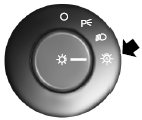
Turn the lighting control to the autolamps position.
Manually overriding the system
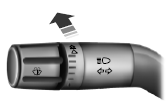
When the automatic control has activated high beams, pushing or pulling the stalk will provide a temporary override to low beam.
To permanently deactivate the system use the information display menu or turn the lighting control switch from autolamps to headlamps.
 Daytime running lamps
WARNING: Always remember to turn on your headlamps at
dusk or during inclement weather. The Daytime Running Lamp
(DRL) system does not activate the tail lamps and generally may not
provide adequate ...
 Direction indicators
• Push down to activate the left
turn signal.
• Push up to activate the right turn
signal.
Note: Tap the lever up or down to make the direction indicators flash
only three times to indica ...
Other materials:
Specifications, Description and Operation, Diagnosis and Testing
SPECIFICATIONS
Material
DESCRIPTION AND OPERATION
Engine
NOTICE: When repairing engines, all parts must be contamination
free. If contamination/foreign material is present when repairing an engine,
premature engine failure may occur.
NOTE: Specifications show the expected minimum or max ...
Diagnosis and Testing
Safety Belt System
Principles of Operation
WARNING: All
safety belt components must be inspected and corrected as part of any collision
repair. Inspect all safety belt components as prescribed by Safety Belt
Inspection and Repair After a Collision found in Section 501-20A General
Procedure ...
Changing the vehicle battery
WARNING: Batteries normally produce explosive gases which
can cause personal injury. Therefore, do not allow flames, sparks
or lighted substances to come near the battery. When working near the
battery, always shield your face and protect your eyes. Always provide
proper ventilation.
WARNING: W ...
