
WARNING:
Sitting improperly out of position or with the seat back reclined too far can take off weight from the seat cushion and affect the decision of the passenger sensing system, resulting in serious injury or death in a crash. Always sit upright against your seat back, with your feet on the floor.
WARNING:
Do not recline the seat back as this can cause the occupant to slide under the seat’s safety belt, resulting in severe personal injury in the event of a crash.
WARNING:
Do not place objects higher than the seat backs to reduce the risk of injury in a crash or during heavy braking or when stopping suddenly.
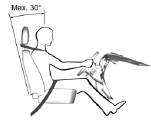
When you use them properly, the seat, head restraint, safety belt and airbags will provide optimum protection in the event of a crash.
We recommend that you follow these guidelines: • Do not recline the seat back more than 30 degrees from vertical.
• Sit in an upright position with the base of your spine as far back as possible.
• Adjust the head restraint so that the top of it is level with the top of your head and as far forward as possible, remaining comfortable.
• Keep sufficient distance between yourself and the steering wheel.
We recommend a minimum of 10 inches (25 centimeters) between your breastbone and the airbag cover.
• Hold the steering wheel with your arms slightly bent.
• Bend your legs slightly so that you can press the pedals fully.
• Position the shoulder strap of the safety belt over the center of your shoulder and position the lap strap tightly across your hips.
Make sure that your driving position is comfortable and that you can maintain full control of your vehicle.
 Seats
Seats
...
 Head restraints
WARNING: To minimize the risk of neck injury in the event of a
crash, the driver and passenger occupants should not sit in or
operate the vehicle, until the head restraint is placed in its proper
p ...
Other materials:
Front End Body Panels
SPECIFICATIONS
Torque Specifications
DESCRIPTION AND OPERATION
Active Grille Shutter System
Overview
The grille shutter system (when equipped) is comprised of the grille shutter
assembly and the grille shutter actuator. The grille shutter system is primarily
used to maximize fuel economy by reduc ...
Manual heating and air conditioning
A. Fan speed control: Controls the volume of air circulated in your
vehicle. Turn to select the desired fan speed or switch off. If you switch
the fan off, the windshield may fog up.
B. Defrost: Distributes air through the windshield defroster vents and
demister vents. This setting can also ...
Engine Ignition - 3.5L GTDI
SPECIFICATIONS
Material
General Specifications
Torque Specifications
a Refer
to the procedure in this section.
DESCRIPTION AND OPERATION
Engine Ignition
3.5L GTDI
System Operation
Refer to the PC/ED manual
section 1 Description and Operation.
Component Description
Refe ...
