
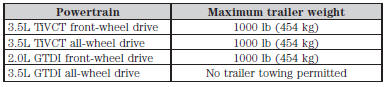
Note: Do not exceed the trailer weight for your vehicle configuration listed in the chart below.
Note: Make sure to take into consideration trailer frontal area. Do not exceed 12 feet2 (1.11 meters2) trailer frontal area.
Note: For high altitude operation, reduce the gross combined weight by 2% per 1000 feet (300 meters) starting at the 1000 foot (300 meter) elevation point.
Note: Certain states require electric trailer brakes for trailers over a specified weight. Be sure to check state regulations for this specified weight. The maximum trailer weights listed may be limited to this specified weight, as your vehicle’s electrical system may not include the wiring connector needed to use electric trailer brakes.
Your vehicle may tow a Class I trailer provided the maximum trailer weight is less than or equal to the maximum trailer weight listed for your vehicle configuration on the following chart.
 Trailer towing
WARNING: Do not exceed the GVWR or the GAWR specified on
the certification label.
WARNING: Towing trailers beyond the maximum recommended
gross trailer weight exceeds the limit of your vehicle and ...
 Essential towing checks
Follow these guidelines for safe towing:
• Do not tow a trailer until you drive your vehicle at least 1000 miles
(1600 kilometers).
• Consult your local motor vehicle laws for towing a traile ...
Other materials:
Engine Ignition - 3.5L Ti-VCT
SPECIFICATIONS
Material
General Specifications
Torque Specifications
DESCRIPTION AND OPERATION
Engine Ignition
Component Location
System Operation
REFER to the PC/ED manual
section 1 Description and Operation.
Component Description
REFER to the PC/ED manual
section 1 Descr ...
Frame and Mounting
Uni-Body, Subframe and Mounting System
SPECIFICATIONS
Torque Specifications
DESCRIPTION AND OPERATION
Subframe and Mounting Systems
The front subframe is bolted to the body and:
aids in structural support.
provides the mounting surface for the steering gear, the front
suspension lower arms, en ...
General Procedures
Brake Shift Interlock Override - Floor Shift
NOTE: If it is necessary to use the override procedure to move
the selector lever out of the PARK position, it is possible that a fuse has
blown. GO to Pinpoint Test A.
This vehicle is equipped with a brake shift interlock feature that prevent ...
